


What Does Touchless Really Mean at a Car Wash in Sacramento
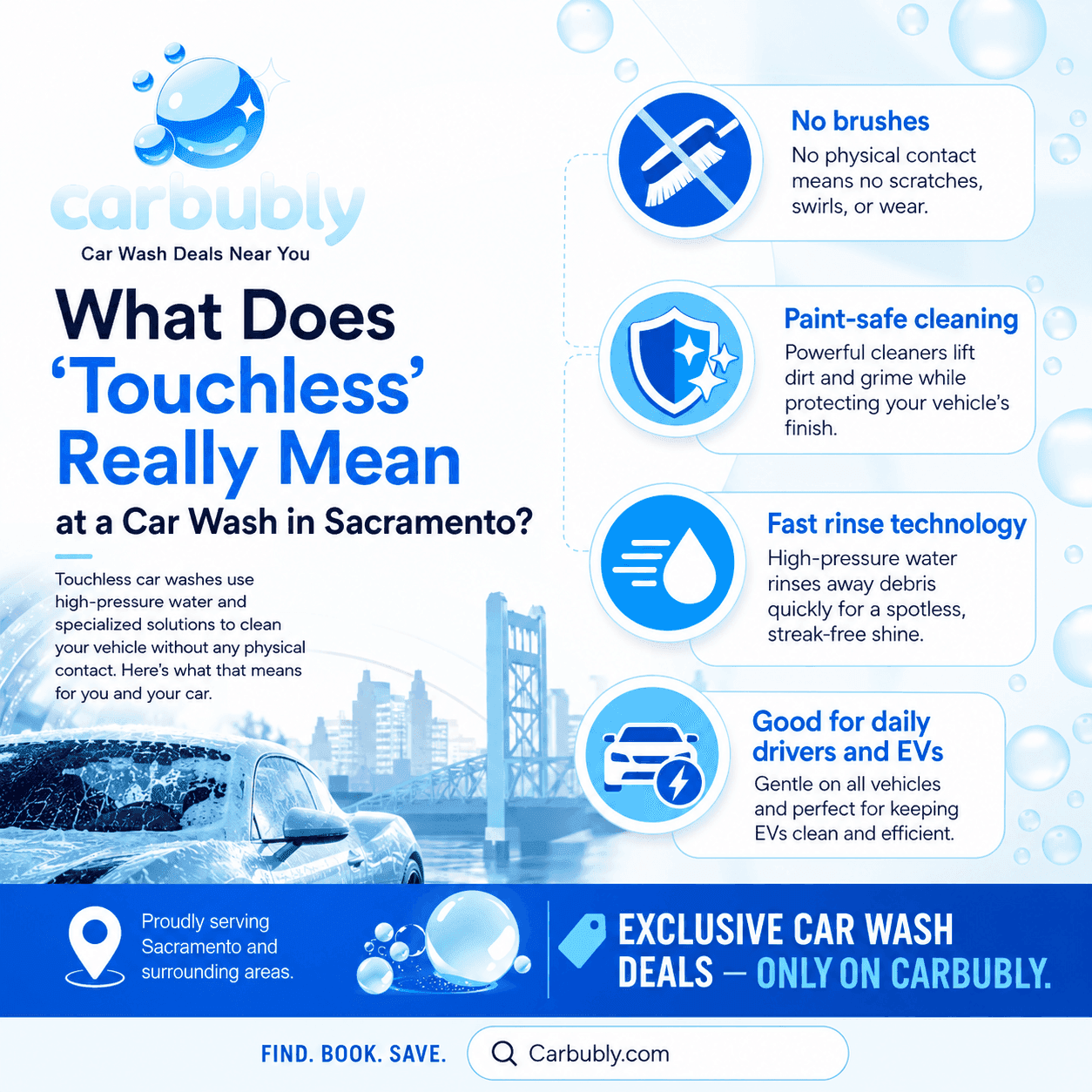
A Carbubly touchless car wash cleans your vehicle using high-pressure water jets and concentrated chemical solutions, with no brushes, cloths, or physical contact with your car's surface at any point during the process. For drivers in Sacramento dealing with dusty summer heat, tree sap, and hard water mineral deposits.
Key Takeaways
Touchless car washes rely entirely on chemical cleaning agents and high-pressure water, not mechanical contact.
No physical contact means zero risk of brush-induced swirl marks or scratches on your paint.
Touchless systems require stronger chemicals to compensate for the lack of agitation, which can affect certain wax coatings over time.
Sacramento's hard water and seasonal dust make the right wash method more important than in many other cities.
Touchless is ideal for vehicles with fresh paint, vinyl wraps, or ceramic coatings.
For heavy grime or interior cleaning, a more comprehensive service like detailing may be necessary.
How Touchless Technology Actually Works
When you pull into a touchless bay, the system follows a precise sequence. First, a pre-soak solution is sprayed across the entire vehicle. This chemical is typically alkaline-based and designed to break down road grime, dust, bird droppings, and grease before any water pressure is applied. After a dwell time of roughly 60 to 90 seconds, high-pressure jets, often operating between 1,000 and 2,000 PSI, rinse the loosened contaminants away.
Most modern systems then apply a second chemical pass, either a foaming detergent or a low-pH acid rinse, to tackle any remaining mineral deposits or oxidation on the surface. A final rinse with softened or filtered water removes all chemical residue, and a forced-air dryer completes the cycle.
Here is what makes the Sacramento context specific: the city's municipal water supply carries measurable mineral content, as noted in annual water quality reports from Sacramento's water utility. Hard water can leave calcium and magnesium deposits on paint, glass, and trim. A properly calibrated touchless car wash uses water softeners or spot-free rinse technology to counteract this, which is why the quality of a local operator matters significantly.
Touchless vs. Soft-Touch: The Difference Every Sacramento Driver Should Know
A lot of confusion at the car wash comes from conflating "touchless" with "soft-touch" or "brushless" systems. They are not the same, and the distinction has real consequences for your paint.
| Feature | Touchless | Soft-Touch (Cloth/Foam) |
| Physical contact with paint | None | Yes (foam pads or cloth strips) |
| Risk of swirl marks | Very low | Low to moderate |
| Cleaning power on heavy soil | Moderate | High |
| Safe for ceramic coatings | Yes | Use caution |
| Safe for vinyl wraps | Generally yes | Risk of edge lifting |
| Chemical intensity | High | Moderate |
| Typical price range | $10 to $25 | $8 to $20 |
Soft-touch systems use rotating foam pads or cloth strips that make gentle but real contact with the surface. While manufacturers engineer these materials to be non-abrasive, contaminated pads carrying grit from a previous vehicle can still cause fine scratches over time. Touchless systems eliminate that variable entirely.
If you are looking for a hand car wash that genuinely protects a ceramic-coated or freshly painted vehicle, the no-contact approach is the safer choice. However, if your truck came back from a camping weekend caked in mud, you may find that chemical-only cleaning has limits.
According to Consumer Reports' auto care guidance, the type of wash you choose can have a meaningful long-term impact on paint condition, particularly for drivers who wash frequently.
Why Sacramento's Climate Makes Your Wash Method More Important
Sacramento sits in a Mediterranean climate zone, which means long, dry summers with temperatures regularly exceeding 100°F, followed by mild, wet winters. That combination creates specific challenges for vehicle surfaces.
During summer, fine particulate dust settles on your paint constantly. When it bakes under direct sun, it bonds lightly to the clear coat. A touchless system using a strong pre-soak can lift this dust without scratching. However, if you let the buildup go for several weeks, even a touchless system may struggle to remove it fully in a single pass.
Winter brings a different problem: road debris, rain-soaked grime, and in some higher-elevation commutes, road salt or traction sand. The California Department of Transportation uses sand on mountain routes like Highway 50 toward Lake Tahoe, and that sand can make its way back to Sacramento on wheel wells and undercarriages. Touchless undercarriage jets handle this well, provided the system includes that feature.
For Sacramento-area drivers who want location-specific service, Carbubly's sacramento location offers touchless options calibrated for local water conditions and seasonal grime patterns. Drivers out in the Folsom corridor can check services available in folsom for comparable options closer to home.
What a Touchless Wash Can and Cannot Clean
Being honest about the limits of touchless technology helps you avoid disappointment. Here is a practical breakdown:
What touchless handles well:
Light to moderate road dust and dirt
Bird droppings (when not baked on for extended periods)
Pollen and tree debris
Light grease from traffic film
Exterior glass and mirror surfaces
Where touchless has real limits:
Heavily caked mud or clay deposits
Tree sap that has hardened on the surface
Tar spots from fresh asphalt
Interior cleaning of any kind
Wheel wells with compacted debris
For anything beyond the exterior surface, professional hand washing by trained technicians gives you the agitation and targeted attention that automated systems cannot replicate, and hand washing allows a detailer to apply appropriate pressure where needed without risking paint scratches across the entire panel.
And when your vehicle needs truly comprehensive care, including interior vacuuming, leather conditioning, or paint decontamination, full service car detailing provides the most thorough result. Detailing addresses issues that no automated wash, touchless or otherwise, can resolve.
The National Institute for Automotive Service Excellence (ASE) offers professional standards that certified detailers follow, giving you a benchmark for quality when evaluating any service provider.
Things to Know
Touchless washes use stronger chemical concentrations than soft-touch systems to compensate for zero agitation. Over time, this can strip some wax-based sealants faster.
Not all "touchless" operations are created equal. Some budget operators use lower-quality pre-soaks that leave residue, especially visible on dark-colored vehicles.
If your vehicle has a ceramic coating, always verify with the coating manufacturer whether the specific chemicals used are compatible before committing to a regular routine.
Sacramento's water hardness varies slightly by season as the city blends water from the American River and Sacramento River. This affects spot-free rinse performance at different times of year.
Most touchless systems take between 3 and 6 minutes per cycle, making them significantly faster than hand washing, which typically runs 20 to 45 minutes depending on vehicle size.
A well-maintained touchless system is cleaned and recalibrated regularly. Asking an operator about their maintenance schedule is a reasonable and worthwhile question.
How to Get the Most Out of a Touchless Wash in Sacramento
Even the best automated system performs better with a few smart habits on your end.
Before you pull in:
Remove any loose exterior accessories like antennas or cargo racks that could interfere with sensors or jets.
Knock off any large mud clumps manually if your vehicle is heavily soiled. This lets the chemicals work on the actual surface film rather than thick debris.
Roll up all windows completely and confirm sunroofs are sealed.
After the wash:
Inspect the vehicle in direct sunlight or under good artificial light. Look at glass edges and trim seams where residue tends to collect.
If you notice water spotting, the rinse system may not have used fully softened water. A quick wipe with a clean microfiber cloth prevents mineral etching.
Apply a spray detailer or quick-detail product every few washes to maintain a hydrophobic surface that helps your next touchless clean perform better.
According to guidance from AAA's automotive care resources, maintaining a consistent exterior care routine, including appropriate washing frequency for your climate, directly extends the life of your vehicle's clear coat.
Ready to Choose the Right Wash for Your Vehicle?
Visit Carbubly to compare services, read about local Sacramento-area options, and find a location near you. Start by identifying what your vehicle needs most right now: a quick touchless cycle for routine maintenance, a thorough hand wash after a road trip, or a full detailing appointment before you list it for sale. Matching the right service to the right situation saves you money and protects your vehicle's value over time.
Frequently Asked Questions
Q: Is a touchless car wash safe for a vehicle with a ceramic coating?
Yes, touchless car washes are generally considered safe for ceramic-coated vehicles.
Because no physical contact occurs, there is no risk of abrasion that could compromise the coating's surface. However, you should confirm that the chemical pre-soaks used are pH-neutral or within a range specified by your coating's manufacturer, as highly alkaline solutions used repeatedly can reduce the coating's hydrophobic performance over time.
Q: How often should Sacramento drivers wash their car using a touchless system?
For most Sacramento drivers, a touchless wash every two to three weeks is a reasonable baseline during dry season.
During summer, fine dust accumulates quickly, particularly if you park outdoors or commute on surface streets. During winter months with more rain, you may wash less frequently, though post-rain washes are worth considering since rain in urban areas can leave its own grime residue once it evaporates.
Q: Can a touchless wash remove bird droppings safely?
A touchless wash can remove bird droppings effectively if they have not been baked on for more than 24 to 48 hours.
Bird droppings are acidic and begin etching clear coat relatively quickly in hot climates like Sacramento's. If the droppings have dried and hardened, a pre-soak alone may not fully lift them. In those cases, a targeted spot treatment by hand before the automated cycle gives the best result.
Q: Why does my dark-colored car still look streaky after a touchless wash?
Streaking on dark vehicles after a touchless wash is most commonly caused by hard water mineral deposits left by an inadequate or poorly maintained spot-free rinse system.
Sacramento's water supply does carry measurable mineral content, and if the wash operator's water softener is not functioning optimally, those minerals stay on the surface after the water evaporates. Choosing a facility that uses a properly maintained reverse osmosis or deionized water final rinse minimizes this issue significantly.
Q: What is the difference between a touchless wash and professional detailing?
A touchless wash cleans the exterior surface automatically in minutes, while professional detailing is a multi-step, manual process that addresses paint correction, interior cleaning, and surface protection in depth.
Detailing can take several hours and includes services like clay bar decontamination, machine polishing, and sealant application that no automated wash can replicate. For regular maintenance, a touchless wash works well. For periodic deep restoration or preparation for sale, detailing provides a fundamentally different and more comprehensive level of care.
The Bottom Line on What 'Touchless' Really Means at a Car Wash in Sacramento
A touchless car wash is a chemistry-first cleaning method that protects your paint from physical abrasion while handling routine exterior maintenance efficiently. In Sacramento's specific climate, where heat, dust, and hard water all work against your vehicle's finish, choosing the right wash method is not a minor detail. It is a practical decision that affects your paint over months and years.
Use a touchless system for regular upkeep, invest in hand washing when you need targeted attention, and schedule professional detailing when your vehicle deserves a full reset. Make your next appointment based on what your vehicle actually needs today.