


Waymo Testing in Sacramento: What It Means
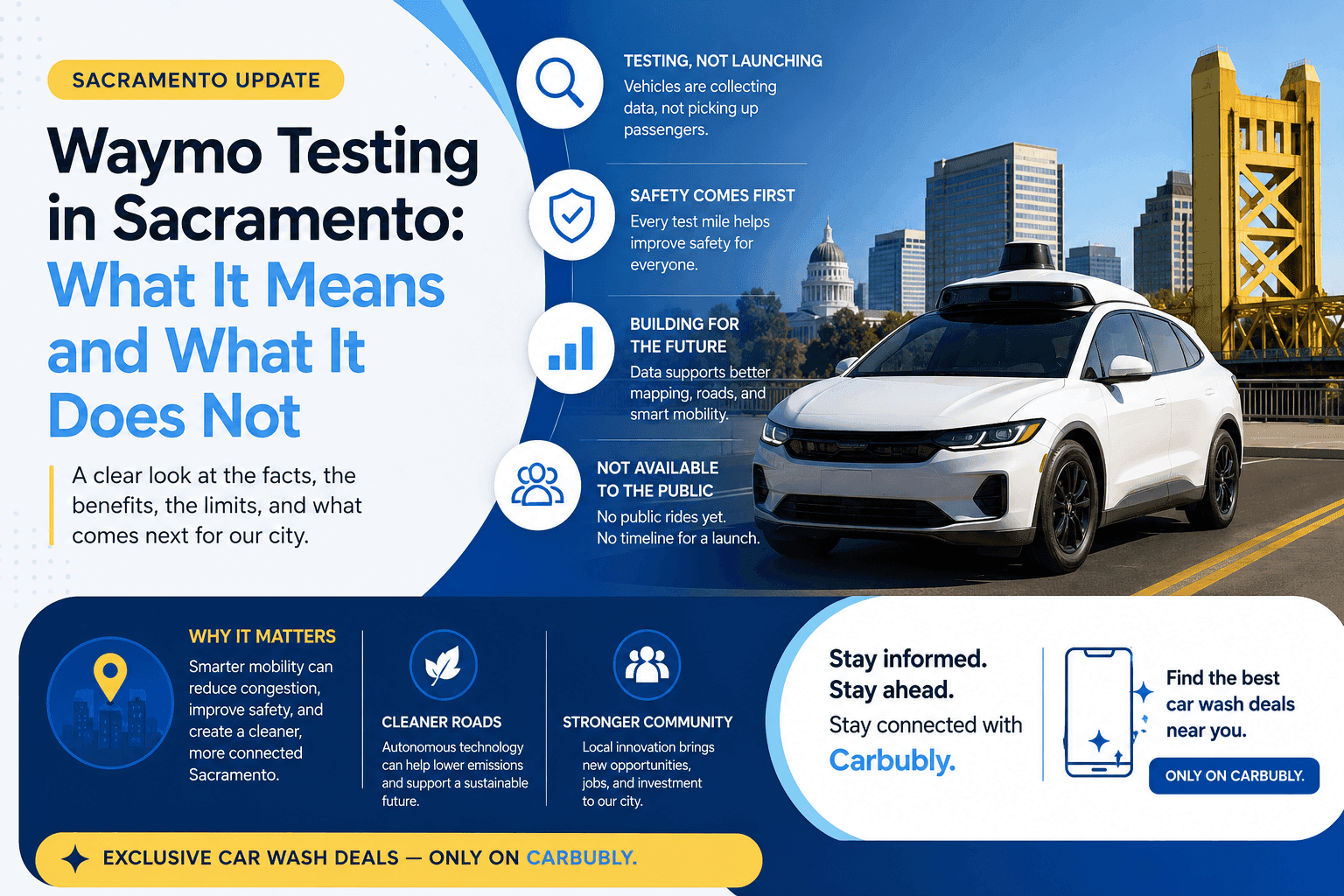
Waymo Testing in Sacramento means Waymo has been preparing its autonomous driving system for local conditions, but it does not automatically mean every Sacramento resident can already hail a fully driverless paid ride anywhere in the city.
That difference matters. Testing, manual driving, driverless testing, approved operating areas, deployment, and public passenger service are not all the same thing. When people hear “Waymo is in Sacramento,” it is easy to jump straight to robotaxis on every street. The real picture is more layered.
Waymo announced in February 2026 that it would begin manually driving a fleet of all-electric Jaguar I-PACE vehicles around Sacramento so the Waymo Driver could learn local driving dynamics, including tree-lined avenues and busy downtown corridors. The California DMV also lists Waymo’s approved areas of operation for driverless testing and deployment, including Sacramento County cities on the page. That creates real local relevance, but readers should still separate testing, deployment authorization, and public ride availability.
This topic also connects to vehicle care in a practical way. Future autonomous and EV fleets still need clean glass, visible cameras, maintained wheels, passenger-ready interiors, charging, inspections, and fleet support. For everyday drivers comparing “Exclusive car wash deals, only on Carbubly.”, the same lesson applies: understand what is actually included before you assume what a service means.
Key Takeaways
Waymo Testing in Sacramento means Sacramento is part of Waymo’s local learning and operating-area conversation, but it does not automatically mean public robotaxi service is available everywhere.
California DMV regulates autonomous vehicle testing and deployment permits in California.
CPUC passenger-service rules may matter when autonomous vehicles are used for paid or pre-arranged rides.
Testing with a safety driver, driverless testing, deployment, and passenger service are different categories.
Autonomous and EV fleets still need practical support, including cleaning, detailing, charging, inspection, and maintenance.
Carbubly is a marketplace for car wash deals that helps drivers discover, compare, purchase, and redeem offers from trusted local car wash and detailing providers.
What Is Waymo Testing in Sacramento?
Waymo Testing in Sacramento refers to Waymo’s process of operating vehicles in the Sacramento area so its autonomous driving system can learn local road conditions, traffic behavior, street layouts, and driving patterns.
Waymo’s official Sacramento announcement said the company would begin manually driving all-electric Jaguar I-PACE vehicles around the Capital City. That detail is important. Manual driving is not the same as fully driverless public passenger service. It is an early local learning phase that helps the system understand the city before broader future use.
Waymo Testing in Sacramento may involve learning from:
Downtown streets
Tree-lined neighborhoods
Busier traffic corridors
Bike lanes
Construction zones
Curbside pickup areas
Rain, fog, glare, and road film
Pedestrian-heavy areas
Freeway approaches
Regional travel patterns
For Sacramento residents, the best way to understand this topic is to think in stages. A company can study local roads before offering rides. It can receive certain regulatory approvals before a public launch. It can test in an approved area without being available to every passenger on demand.
What Waymo Testing in Sacramento Does Mean
Waymo Testing in Sacramento does mean Sacramento is being treated as a real operating environment, not just a theoretical market.
It can mean:
Waymo vehicles may be seen on local roads.
The company is studying Sacramento-specific driving conditions.
Local road design, traffic behavior, and curbside activity matter.
Sacramento is part of California’s broader autonomous vehicle conversation.
State-level regulation is involved.
Future fleet operations could require charging, staging, cleaning, and inspection routines.
The California DMV’s Autonomous Vehicles Program says the DMV administers the state AV program and issues permits to manufacturers that test and deploy autonomous vehicles on California public roads. So when Sacramento residents hear about Waymo testing, the DMV is one of the key agencies to understand.
For local drivers, the practical meaning is simple: autonomous vehicles are becoming part of the Sacramento mobility conversation, but official details matter.
What Waymo Testing in Sacramento Does Not Mean
Waymo Testing in Sacramento does not automatically mean:
Every Waymo vehicle is driverless.
Public paid rides are available everywhere.
Any autonomous vehicle can operate without limits.
Sacramento alone controls the entire approval process.
Testing is the same as full commercial service.
A Waymo vehicle seen on the road is necessarily carrying passengers.
Every EV or Tesla is a driverless autonomous vehicle.
Local car washes need to claim they are “robotaxi certified.”
This is where many misunderstandings happen. A news headline may say “Waymo in Sacramento,” but the details can refer to manual driving, driverless testing approval, operating-area expansion, or future ride plans. These are different things.
For residents, the best question is not only “Is Waymo here?” It is:
What type of activity is authorized?
Is there a safety driver?
Is the vehicle carrying passengers?
Is it paid service?
What agency approved the activity?
What operating conditions apply?
Is public access available yet?
That kind of careful reading prevents confusion.
Why This Matters for Sacramento Residents
Waymo Testing in Sacramento matters because autonomous vehicles affect more than one company. They touch local streets, curbs, parking, public safety, passenger trust, fleet care, and how people understand future transportation.
Sacramento has a mix of downtown streets, state offices, neighborhoods, suburban commute routes, event traffic, school zones, bike lanes, and regional connections. Autonomous vehicles have to operate inside that real environment.
Residents may care about:
Traffic flow
Safe pickup and drop-off areas
Curbside access
Emergency vehicle response
Pedestrian safety
Bike lane protection
Parking impacts
Public ride availability
Local business access
Fleet staging and charging
Vehicle cleaning and maintenance
The City of Sacramento has an autonomous vehicles information page that explains autonomous car services in plain terms and points residents toward state resources. That local context matters because state approval is only one part of how people experience AVs on real streets.
What Do the Statistics Say?
A few reliable sources help explain the bigger picture behind Waymo Testing in Sacramento.
The road system is already crowded. The Federal Highway Administration reported 284,614,269 registered motor vehicles in the United States in 2023 in its State Motor-Vehicle Registrations table. That means autonomous vehicles will share roads with a huge number of human-driven cars, SUVs, trucks, vans, EVs, work vehicles, delivery vehicles, and family cars.
California has a formal AV permit system. The California DMV says it issues permits to manufacturers that test and deploy autonomous vehicles on public roads. This means Waymo activity in Sacramento should be understood through official permit categories, not vague claims.
Waymo has official Sacramento context. Waymo announced manual driving in Sacramento using all-electric Jaguar I-PACE vehicles as part of the Waymo Driver’s local learning process. That supports the idea that Sacramento is part of Waymo’s planned expansion work, while still requiring careful interpretation of what is currently available.
Vehicle washing has environmental responsibility. EPA guidance on vehicle maintenance and washing explains that vehicle washing can release pollutants such as hydrocarbons and heavy metals when wash water is not handled properly. That matters for future fleets because repeated vehicle cleaning should be planned responsibly.
The takeaway is simple: Waymo testing is not just a technology story. It fits into a larger system of roads, regulations, environmental practices, fleet care, and public trust.
How Does Waymo Testing Work in Plain Language?
A simplified testing process may look like this:
Vehicles drive in a target city or region.
The system learns local road layouts and driving patterns.
Engineers study how the vehicle handles real-world situations.
Routes, conditions, and edge cases are reviewed.
Vehicles may operate manually, with a safety driver, or driverlessly depending on authorization and phase.
Regulators oversee categories of testing and deployment.
Passenger service may require additional approval depending on the service type.
For Sacramento, local testing may involve understanding downtown corridors, changing lanes, curb behavior, construction, pedestrians, cyclists, weather, and Sacramento-specific street conditions.
A helpful way to think about it: autonomous testing is not only “can the car drive?” It is also “can the system operate reliably in this specific place under defined conditions?”
Testing vs Deployment vs Passenger Service
These terms are easy to mix up, so it helps to compare them clearly.
Manual driving for local learning: A vehicle is driven by a human while the company collects local road and operational data.
Testing with a safety driver: The vehicle may operate autonomous technology with a human safety driver inside.
Driverless testing: The vehicle may test without a human driver inside under approved conditions.
Deployment: The company is authorized to operate autonomous vehicles beyond testing, subject to regulatory rules and limits.
Passenger service: The vehicle carries passengers as part of a transportation service. Depending on the service, CPUC rules may apply in California.
Public ride availability: Residents can actually open an app, request a ride, and use the service in a specific area.
Those are not the same. When someone says “Waymo is testing in Sacramento,” they should not automatically assume public driverless rides are available.
How Waymo Testing Connects to Fleet Cleaning and Maintenance
Autonomous vehicles may be advanced, but they still need practical care.
Waymo-style EV fleets, robotaxis, or future autonomous vehicles may need:
Charging
Tire checks
Glass cleaning
Camera-area cleaning
Sensor-adjacent cleaning
Exterior washing
Wheel cleaning
Interior resets
Trash removal
Lost-item checks
Odor checks
Service records
Fleet staging
A vehicle that drives around Sacramento may collect dust, pollen, rain residue, bug splatter, bird droppings, brake dust, road film, and interior mess. If it carries passengers, the inside matters as much as the outside.
Cleaning does not replace safety engineering or regulatory approval. But it can support visibility checks, inspection routines, passenger comfort, and fleet readiness.
Service Comparison: What Cleaning Options Fit Modern AV and EV Fleets?
Different service types solve different problems.
Touchless car wash: Useful for light dust, pollen, rain spots, and lower-contact exterior cleaning. Drivers looking for a touchless car wash near me can explore touchless car wash services when avoiding brush contact is a priority.
Hand car wash: Useful for bugs, wheels, lower panels, mirrors, and areas near cameras or sensors that may need careful attention. Drivers looking for a hand car wash near me can compare hand car wash services when a quick automatic wash may not be enough.
Full-service detailing: Useful for interiors, passenger vehicles, rideshare cars, family SUVs, EVs, Teslas, and high-use fleet vehicles. Drivers searching for full-service car detailing near me can book full-service car detailing when seats, mats, glass, stains, odors, cup holders, or cargo areas need deeper care.
Mobile detailing: Useful for fleet lots, office locations, homes, charging hubs, or approved parking areas. This can fit searches like mobile detailing near me when convenience matters.
Express car wash: Useful for fast exterior maintenance when the vehicle is lightly dirty and needs to get back on the road.
A future fleet may use more than one service type depending on vehicle condition, schedule, route, and passenger use.
How to Choose the Best Option Today
Most drivers are not operating autonomous fleets, but the same logic helps with everyday car care.
Best for budget
Choose the most affordable service that solves the actual problem.
Good budget choices include:
Express wash for light dust
Touchless wash for lower-contact cleaning
Hand wash for bugs, wheels, and lower panels
Interior add-ons only when needed
Full-service detailing only when deeper care is necessary
A driver searching for an affordable car wash near me should still check what the package includes. Low price only helps when the service fits the car.
Best for convenience
Choose a provider near your real route, not just the closest map pin. Drivers can compare car wash deals in Sacramento, car wash deals in Citrus Heights, car wash deals in Roseville, car wash deals in Rancho Cordova, car wash deals in Folsom, car wash deals in Elk Grove, car wash deals in Davis, and car wash deals in West Sacramento.
Convenience includes location, timing, appointment rules, package clarity, service speed, vehicle compatibility, and redemption terms.
Best for protection and detailing
Choose more careful service when the vehicle has:
Cameras or sensors
Tesla or EV-specific needs
Ceramic coating
Paint protection film
Vinyl wrap
Dark paint
Heavy bugs
Dirty wheels
Interior stains
Pet hair
Odors
Frequent passengers
Rideshare or delivery use
For Tesla owners, review Tesla’s car wash guidance before automatic wash services. Follow the current owner manual and provider instructions.
How “Car Wash Near Me” Search Intent Connects to Waymo Testing
Waymo Testing in Sacramento may sound like a transportation topic, but it also raises everyday questions about local vehicle care.
When drivers search car wash near me, best car wash near me, Tesla car wash near me, or EV-safe car wash near me, they are often trying to find a nearby provider that can handle a modern vehicle properly. They want clear packages, reliable service, fair pricing, and confidence that the provider understands what the vehicle needs.
That local search behavior matters because future AV and EV fleets will also need service matching. A fleet vehicle will not only need the nearest wash. It will need the right wash.
A driver might look for:
Car wash deals near me before booking a quick exterior wash
Touchless car wash near me after light dust or rain
Hand car wash near me after bug-heavy freeway driving
Full-service car detailing near me after interior wear
Mobile detailing near me for convenience at home or work
Local car wash near me when comparing trusted nearby providers
The future of vehicle care may become more technology-assisted, but the basic decision stays human: choose a provider that fits the vehicle.
Common Mistakes to Avoid
Assuming testing means public rides. Waymo Testing in Sacramento does not automatically mean public paid driverless rides are available everywhere.
Confusing manual driving with driverless operation. Waymo’s Sacramento announcement specifically described manually driving all-electric Jaguar I-PACE vehicles for local learning.
Ignoring DMV categories. Testing, driverless testing, and deployment are different regulatory categories.
Forgetting CPUC passenger-service rules. Passenger service can involve separate rules from vehicle testing.
Treating every EV as autonomous. EVs, Teslas, driver-assistance systems, and autonomous vehicles are related but not identical.
Overstating local impact. AV testing may be visible, but broader service availability depends on authorization and rollout.
Ignoring vehicle care. Autonomous and sensor-heavy vehicles still need clean glass, cameras, wheels, tires, and interiors.
Choosing car care only by price. The cheapest wash may not fit an EV, Tesla, rideshare car, or sensor-heavy vehicle.
Not checking manufacturer guidance. Tesla owners should review current wash guidance before choosing certain automatic wash services.
Trusting vague headlines. Use official sources when checking what is actually authorized.
Where Carbubly Fits Naturally
Carbubly is a marketplace for car wash deals that helps drivers discover, compare, purchase, and redeem offers from trusted local car wash and detailing providers.
Carbubly is not a car wash operator. It does not personally wash vehicles. Instead, it helps drivers compare local providers offering hand car wash, touchless car wash, express wash, mobile detailing, full-service detailing, Tesla car wash options, EV-safe car wash preferences, and other vehicle-cleaning services.
Start with Carbubly when you want to compare affordable car wash options, trusted car wash services, local car wash providers, and car wash savings. You can also view Carbubly on Google Maps for local trust context.
As Waymo Testing in Sacramento makes more residents curious about autonomous vehicles, car care becomes part of the bigger local mobility conversation. Modern vehicles still need clean glass, maintained cameras, clear lights, cared-for interiors, and trusted providers.
Final Tips Before Interpreting Waymo News
Use this checklist when reading about Waymo Testing in Sacramento:
Check whether the news is about manual driving, testing, driverless testing, deployment, or passenger service.
Look for official Waymo, DMV, CPUC, or City of Sacramento sources.
Do not assume public rides are available unless clearly stated.
Separate EVs from autonomous vehicles.
Separate driver-assistance features from driverless operation.
Watch for where vehicles are actually authorized to operate.
Remember that local streets, curbs, and pickup zones still matter.
Think about charging, cleaning, maintenance, and staging—not only software.
Be cautious with social media claims that do not include official source links.
For your own vehicle, choose car wash services based on condition, not hype.
The practical question is always: what is actually happening, who authorized it, and what does it mean for local drivers?
Conclusion: Waymo Testing in Sacramento
Waymo Testing in Sacramento means Sacramento is part of Waymo’s local learning and autonomous mobility planning, but it does not automatically mean public driverless ride service is available everywhere today. Residents should understand the difference between manual driving, testing, driverless testing, deployment, and passenger service.
The topic also shows how future mobility depends on more than software. Autonomous and EV fleets need regulation, charging, clean glass, sensor-area care, interior cleaning, fleet maintenance, responsible wash practices, and local service support.
Carbubly helps drivers compare car wash and detailing deals from trusted local providers today. Visit Carbubly to compare nearby options and choose the service that fits your vehicle, schedule, and budget.
FAQs About Waymo Testing in Sacramento
1. What does Waymo Testing in Sacramento mean?
Waymo Testing in Sacramento means Waymo is using Sacramento as a local operating environment to help its autonomous driving system learn local roads, traffic patterns, and city conditions.
2. Does Waymo Testing in Sacramento mean public rides are available?
Not automatically. Testing, manual driving, driverless testing, deployment, and public passenger service are different stages. Public availability should be checked through official Waymo and regulatory sources.
3. What vehicles did Waymo mention for Sacramento?
Waymo announced that it would begin manually driving all-electric Jaguar I-PACE vehicles around Sacramento as part of an initial local learning phase.
4. Who regulates autonomous vehicle testing in California?
The California DMV administers the state’s Autonomous Vehicles Program and issues permits to manufacturers that test and deploy autonomous vehicles on public roads.
5. Does Sacramento regulate Waymo by itself?
No. Sacramento has local mobility and street concerns, but California DMV and, for certain passenger services, CPUC are important state-level agencies.
6. Why does Waymo testing matter for local drivers?
It matters because autonomous vehicles can affect local streets, curbs, pickup zones, traffic behavior, passenger service, fleet care, and public understanding of future mobility.
7. How does Waymo testing connect to car washing?
Autonomous and EV fleets still need clean glass, cameras, lights, wheels, interiors, and service records. Cleaning can support visibility checks, inspections, and passenger trust.
8. Are touchless washes useful for autonomous or EV fleets?
Touchless washes can help with light exterior dirt and lower-contact cleaning, but bugs, wheels, interiors, and sensor-adjacent areas may still need hand washing or detailing.
9. What should Tesla owners know about car washing?
Tesla owners should review current Tesla wash guidance and choose providers that understand charge ports, cameras, glass, trim, wheels, and manufacturer instructions.
10. Where can Sacramento drivers compare car wash deals?
Sacramento drivers can compare car wash deals on Carbubly, a marketplace that helps drivers discover, compare, purchase, and redeem offers from trusted local car wash and detailing providers.