


Sensor Placement for Autonomous Vehicle Wash
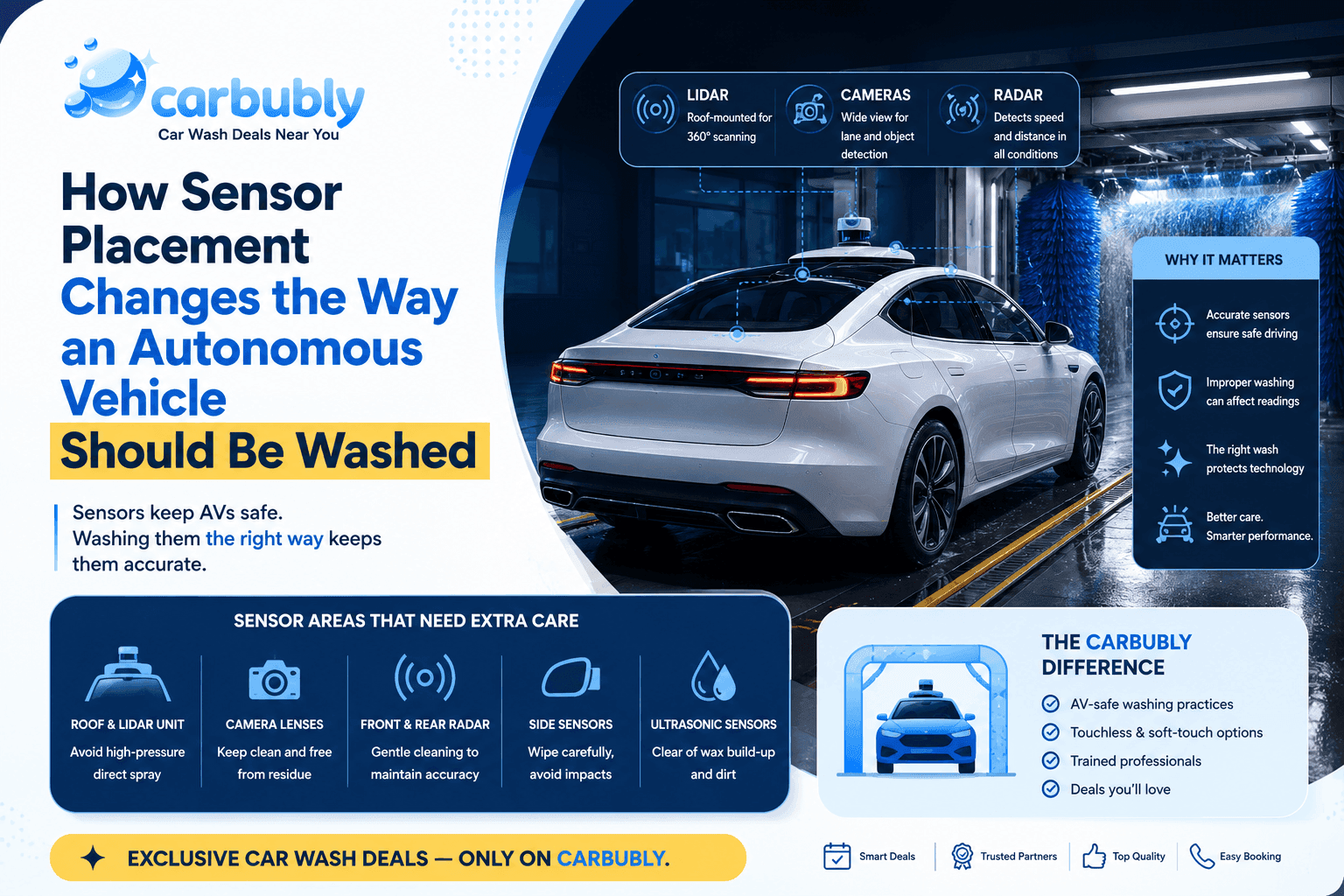
How Sensor Placement Changes the Way an Autonomous Vehicle Should Be Washed comes down to one practical idea: the areas around cameras, radar, lidar, glass, mirrors, lights, bumpers, and other sensor locations may need more careful cleaning than a normal exterior wash focused only on shine.
Modern vehicles are not just paint, wheels, windows, and trim anymore. Many newer cars, EVs, Teslas, premium SUVs, and autonomous test vehicles use cameras, radar units, parking sensors, ultrasonic sensors, and sometimes lidar hardware to help the vehicle understand what is around it. Dirt on the hood may be mostly cosmetic. Dirt on a camera lens, windshield area, front bumper sensor zone, or rear camera housing can matter more.
That does not mean washing a sensor-heavy car is scary. It means the cleaning process should be more thoughtful. A good wash should remove dust, pollen, bugs, road film, mud, brake dust, and water spots while avoiding careless scrubbing, dirty towels, harsh pressure in sensitive areas, or skipped sensor-adjacent zones.
For drivers comparing “Exclusive car wash deals, only on Carbubly.”, this topic is useful even if you do not own a fully autonomous car. Many everyday vehicles already have advanced driver-assistance features, cameras, parking sensors, EV-specific wash steps, and delicate exterior surfaces.
Key Takeaways
Sensor placement changes washing because some areas matter for visibility, vehicle inspection, and driver-assistance system awareness.
Cameras, radar areas, lidar housings, mirrors, glass, lights, bumpers, and charge-port areas may need extra care.
Touchless washing can be useful for light dirt, but hand washing may be better for bugs, wheels, lower panels, and sensor-adjacent grime.
Full-service detailing helps when the interior, glass, mats, seats, and touchpoints also need attention.
Tesla and EV owners should review vehicle-specific wash guidance before using automatic or specialty wash services.
Carbubly is a marketplace for car wash deals that helps drivers discover, compare, purchase, and redeem offers from trusted local car wash and detailing providers.
What Does Sensor Placement Mean on an Autonomous Vehicle?
Sensor placement means where a vehicle’s cameras, radar, lidar, ultrasonic sensors, parking sensors, and related hardware are located on the body of the car.
Depending on the vehicle, sensors and related vision areas may be located near:
The windshield
Front bumper
Rear bumper
Side mirrors
Front fenders
Grille area
Headlights
Taillights
Rear hatch or trunk
Roofline
Door pillars
Side body panels
License plate area
Interior-facing camera zones
Surround-view camera locations
Not every vehicle has the same sensor setup. A Tesla, Waymo vehicle, luxury SUV, driver-assistance car, EV, or future robotaxi may place sensors in different areas. That is why the safest general rule is simple: clean carefully, follow the owner manual, avoid assumptions, and do not treat every vehicle like an older car with no cameras or sensors.
Sensor placement changes the wash process because some areas are easy to miss. A rear camera near the license plate can collect road film. A front bumper may collect bugs and grime. A windshield camera area may be affected by streaky glass. Side cameras can collect dust, pollen, and water spots. Wheel grime can splash onto lower sensors or body panels.
A clean vehicle is not automatically a safe autonomous vehicle. But a dirty sensor-adjacent area can make inspection and visibility harder.
Why Sensor Placement Changes the Way an Autonomous Vehicle Should Be Washed
Sensor placement changes washing because the wash has to protect both the vehicle’s finish and the vehicle’s visibility-related surfaces.
Traditional car washing often focuses on appearance:
Is the paint shiny?
Are the wheels clean?
Is the glass streak-free?
Does the car look good from a distance?
Sensor-aware washing adds another layer:
Are camera areas clean?
Is the windshield clear near camera zones?
Are front and rear bumper areas free of bugs and road film?
Are side mirrors and side cameras clean?
Are lights visible?
Are sensor-adjacent areas dried properly?
Is there residue left behind by soap or wax?
Were delicate trim and EV components handled carefully?
NHTSA explains that vehicles with automated driving systems available for normal consumer purchase are still a future technology, not something a consumer can simply buy and use today as a fully self-driving vehicle. That is an important reminder to stay realistic when discussing autonomous cars. But many vehicles already use driver-assistance features, cameras, and sensors, so careful cleaning is relevant now. NHTSA automated vehicle safety guidance
For Sacramento-area drivers, this matters because local conditions can be tough on exterior surfaces. Dust, pollen, rain film, bugs, freeway grime, tree sap, brake dust, and hot sun can all affect how a vehicle looks and how easy it is to inspect.
What Do the Statistics and Sources Say?
A few trusted sources help explain why sensor-aware vehicle cleaning matters.
The vehicle system is large. The Federal Highway Administration reported 284,614,269 registered motor vehicles in the United States in 2023 in its State Motor-Vehicle Registrations table. That shows how many vehicles, service needs, and wash decisions exist across personal cars, SUVs, trucks, EVs, work vehicles, rideshare cars, and family vehicles.
Autonomous vehicle activity is regulated in California. The California DMV says it administers the Autonomous Vehicles Program and issues permits to manufacturers that test and deploy autonomous vehicles on California public roads. That matters because autonomous technology is regulated, not just a general consumer feature. California DMV Autonomous Vehicles Program
Vehicle washing can affect the environment. EPA guidance on vehicle maintenance and washing explains that improper washing can release pollutants such as hydrocarbons and heavy metals into local waterways. For frequent washing of EVs, fleet vehicles, or sensor-heavy cars, responsible wash-water handling matters.
Fleet washing needs planning. EPA guidance on municipal vehicle and equipment washing notes that wash water can contain sediment, detergents, oils, grease, and heavy metals when not properly captured or treated. This supports the idea that repeated vehicle cleaning should be organized, especially for fleets.
EV wash instructions can be vehicle-specific. Tesla’s Model Y car wash guidance discusses Car Wash Mode and wash-related precautions. That is a practical example of why modern vehicles may need specific wash steps.
The takeaway is simple: sensor placement, regulation, environmental responsibility, and vehicle-specific guidance all shape modern car washing.
How Sensor-Aware Washing Works
Sensor-aware washing starts with a quick inspection before soap ever touches the vehicle.
A careful process may include:
Checking where cameras and sensors are located
Pre-rinsing loose dirt, dust, and grit
Removing bugs gently from front-facing areas
Cleaning glass carefully
Using separate tools for wheels and paint
Avoiding harsh scrubbing near delicate housings
Washing from top to bottom
Rinsing soap fully from sensor-adjacent areas
Drying with clean microfiber towels
Checking camera and glass areas after drying
Following EV or manufacturer-specific wash steps
This approach does not mean the detailer is calibrating or testing the sensors. That is a different technical process. Cleaning supports visibility and inspection, but it does not replace maintenance, software validation, calibration, or manufacturer service.
A good provider should be honest about that. A car wash can clean around sensors. It should not claim to certify autonomous system performance unless it truly provides that specialized service.
Which Vehicle Areas Need Extra Attention?
Sensor placement can vary, but these areas often deserve careful cleaning.
Windshield and camera zones
Many vehicles place cameras behind or near the windshield. Streaky glass, dust, water spots, or film can make the area harder to inspect.
Good care includes:
Clean exterior windshield
Clean interior glass when needed
No greasy residue
Careful drying
No harsh chemicals near sensitive interior areas
Front bumper and grille area
The front of the car collects bugs, road film, mud, and splashes. Some vehicles may have radar or sensor areas in or near the front bumper.
Good care includes:
Pre-soaking bugs
Gentle removal
Avoiding aggressive scraping
Rinsing residue thoroughly
Checking lower panels
Rear camera and hatch area
Rear cameras often sit near the license plate, trunk, hatch, or rear handle. This area collects road grime quickly.
Good care includes:
Cleaning around the camera housing
Removing film from the rear glass
Checking license plate area
Drying carefully to avoid streaks
Side mirrors and side cameras
Side mirrors collect bugs, dust, rain spots, and fingerprints. Some vehicles also place cameras around the side mirror or pillar area.
Good care includes:
Cleaning mirror glass
Wiping camera-adjacent trim carefully
Drying edges
Avoiding rough towel drag
Wheels, tires, and lower panels
Wheels collect brake dust and road grime. Lower panels collect mud and dirty splashback. These areas should not share towels with paint or glass.
Good care includes:
Separate wheel tools
Separate towels
Lower-panel rinse
Tire and wheel attention
Avoiding dirty towel transfer
Touchless, Hand Wash, or Full Detailing?
Different services fit different sensor-aware cleaning needs.
Touchless car wash: Useful for light dust, pollen, rain spots, and lower-contact exterior cleaning. Drivers can explore touchless car wash services when avoiding brush contact is a priority.
Hand car wash: Better for bugs, wheels, lower panels, mirrors, and camera-adjacent areas that may need careful human attention. Drivers can compare hand car wash services when a basic automatic wash may not remove stubborn grime.
Full-service car detailing: Best when the vehicle also needs interior glass, mats, seats, cup holders, stains, odors, or deeper cleaning. Drivers can book full-service car detailing when the car needs more than an exterior rinse.
Mobile detailing: Useful when service at home, work, a fleet lot, or approved parking area is more convenient.
Express car wash: Best for quick exterior maintenance when the vehicle is lightly dirty and speed matters more than detailed attention.
The right service depends on the vehicle’s condition, not only the vehicle’s technology.
How to Choose the Best Option
Best for budget
Choose the lowest-cost service that solves the actual cleaning problem.
Budget-friendly choices may include:
Express wash for light dust
Touchless wash for lower-contact exterior cleaning
Basic hand wash for bugs, wheels, or lower panels
Interior add-on only when the cabin needs it
Full detailing only when the vehicle needs deeper cleaning
A driver searching for an affordable car wash near me should still check what is included. A cheap exterior wash is not useful if camera areas, wheels, or interior glass are still dirty.
Best for convenience
Choose a provider near your real route, not only the closest map pin.
Drivers can compare car wash deals in Sacramento, car wash deals in Citrus Heights, car wash deals in Roseville, car wash deals in Rancho Cordova, car wash deals in Folsom, car wash deals in Elk Grove, car wash deals in Davis, and car wash deals in West Sacramento.
Convenience includes location, appointment rules, service speed, package details, EV handling, Tesla awareness, add-ons, and redemption terms.
Best for protection and detailing
Choose more careful service when your vehicle has:
Cameras or sensors
Tesla or EV-specific needs
Ceramic coating
Paint protection film
Vinyl wrap
Dark paint
Heavy bugs
Dirty wheels
Interior stains
Pet hair
Odors
Frequent passenger use
Rideshare or delivery use
For these vehicles, hand washing, mobile detailing, or full-service detailing may make more sense than the fastest exterior-only option.
How “Car Wash Near Me” Search Intent Connects to Sensor Placement
When drivers search car wash near me, they usually want a nearby place fast. But sensor-heavy vehicles need a little more thought. The closest option may not be the best one if the provider does not explain its process.
More useful searches may include:
Touchless car wash near me for lower-contact exterior cleaning
Hand car wash near me for bugs, wheels, and careful exterior work
Full-service car detailing near me for interior and exterior reset
Mobile detailing near me for cleaning at home or work
Express car wash near me for fast light cleaning
Tesla car wash near me for vehicle-specific wash awareness
EV-safe car wash near me for modern vehicle care
Car wash deals near me for savings on the service you actually need
City-based searches can help too. A driver may want a Sacramento car wash during the workweek, touchless car wash in Citrus Heights after rain, hand car wash in Roseville after freeway bugs, full-service detailing in Rancho Cordova after interior mess, car wash deals in Folsom for weekend errands, car wash options in Elk Grove, local car wash providers in Davis, or car wash deals in West Sacramento.
The best local result is not just nearby. It is nearby and appropriate for the vehicle.
Common Mistakes to Avoid
Assuming every wash is sensor-aware. A provider may offer a good basic wash without being careful around camera or sensor-adjacent areas.
Using dirty towels on paint or glass. Dirty towels can drag grit across surfaces.
Skipping the pre-rinse. Loose dust and grit should be rinsed before contact cleaning.
Using the same tools on wheels and paint. Wheel grime and brake dust should stay away from painted panels.
Scrubbing bugs too aggressively. Bug residue should be softened and removed carefully.
Ignoring rear cameras. Rear camera areas often collect road film and fingerprints.
Forgetting interior glass. Windshield and camera-related visibility can be affected by interior film too.
Assuming touchless removes everything. Touchless washing may not fully remove heavy bugs, wheels, or stubborn grime.
Ignoring EV guidance. Tesla and EV owners should follow current manufacturer instructions.
Overstating what cleaning does. Cleaning supports visibility and inspection, but it does not calibrate or certify autonomous systems.
Where Carbubly Fits Naturally
Carbubly is a marketplace for car wash deals that helps drivers discover, compare, purchase, and redeem offers from trusted local car wash and detailing providers.
Carbubly is not a car wash operator. It does not personally perform washes or detailing. Instead, it helps drivers compare local providers offering hand car wash, touchless car wash, express wash, mobile detailing, full-service detailing, Tesla car wash options, EV-safe car wash preferences, and other vehicle-cleaning services.
Start with Carbubly when you want to compare affordable car wash options, trusted car wash services, local car wash providers, and car wash savings. You can also view Carbubly on Google Maps for local trust context.
As sensor-heavy vehicles become more common, comparison becomes more important. Drivers need to know what service is available, what is included, whether the provider understands EVs and Teslas, and whether the wash fits the car’s actual condition.
Final Tips Before Choosing a Sensor-Aware Wash
Use this checklist before booking:
Is the vehicle lightly dusty or heavily dirty?
Are bugs, sap, or bird droppings present?
Are cameras or sensors visible on the vehicle?
Is the windshield streaky or filmed?
Are side mirrors, rear cameras, and lights clean?
Are wheels and lower panels dirty?
Is the vehicle an EV or Tesla?
Does the owner manual include wash guidance?
Is touchless, hand wash, mobile detailing, or full-service detailing the best fit?
Does the provider explain what is included?
Are glass, drying, wheels, mats, and add-ons clear?
Are there car wash deals near me that match the actual need?
Does the provider avoid exaggerated claims about autonomous systems?
A smart wash choice is simple: clean the vehicle carefully, follow vehicle guidance, and choose the service that matches the problem.
Conclusion: How Sensor Placement Changes the Way an Autonomous Vehicle Should Be Washed
How Sensor Placement Changes the Way an Autonomous Vehicle Should Be Washed is mainly about paying closer attention to the areas that help a modern vehicle see, sense, and stay easier to inspect. Cameras, glass, mirrors, lights, bumpers, radar areas, lidar housings, wheels, and lower panels all deserve thoughtful care.
For today’s drivers, the lesson is practical. Do not choose a wash only because it is close or cheap. Choose the service that fits your vehicle’s condition, technology, paint, interior, and manufacturer guidance.
Carbubly helps drivers compare car wash and detailing deals from trusted local providers today. Visit Carbubly to compare nearby options and choose the service that fits your vehicle, schedule, and budget.
FAQs About Sensor Placement and Autonomous Vehicle Washing
1. How Sensor Placement Changes the Way an Autonomous Vehicle Should Be Washed?
How Sensor Placement Changes the Way an Autonomous Vehicle Should Be Washed is by making camera areas, glass, bumpers, mirrors, lights, and sensor-adjacent zones more important during cleaning.
2. Why does sensor placement matter during a car wash?
Sensor placement matters because dirt, bugs, road film, water spots, or soap residue near cameras and sensors can make the vehicle harder to inspect and keep clean.
3. Does washing clean or calibrate autonomous sensors?
No. Washing can clean exterior surfaces around sensors, but it does not calibrate, repair, test, or certify autonomous vehicle systems.
4. Is touchless washing good for sensor-heavy vehicles?
Touchless washing can be useful for light dirt and lower-contact exterior cleaning, but bugs, wheels, lower panels, and sensor-adjacent grime may still need hand washing.
5. Is hand washing better for autonomous vehicles?
Hand washing can be better when the vehicle has bugs, dirty wheels, lower-panel grime, mirrors, or specific areas that need careful human attention.
6. What areas should be cleaned carefully on a sensor-heavy vehicle?
Important areas include the windshield, rear camera area, side mirrors, front bumper, rear bumper, lights, wheel areas, and any visible camera or sensor housings.
7. Should Tesla owners follow special wash guidance?
Yes. Tesla owners should review current Tesla wash guidance and choose providers that understand Car Wash Mode, charge ports, cameras, glass, trim, and careful drying.
8. Can a regular car wash handle vehicles with cameras and sensors?
Many regular car washes can clean modern vehicles, but drivers should check the service type, package details, vehicle guidance, and provider care before booking.
9. How do I search for a car wash near me for sensor-heavy vehicles?
Search by service need, such as touchless car wash near me, hand car wash near me, full-service car detailing near me, Tesla car wash near me, or EV-safe car wash near me.
10. Where can drivers compare car wash and detailing deals?
Drivers can compare car wash and detailing deals on Carbubly, a marketplace that helps drivers discover, compare, purchase, and redeem offers from trusted local car wash and detailing providers.