


How to Prepare Roof Racks and Accessories for a Touchless Wash
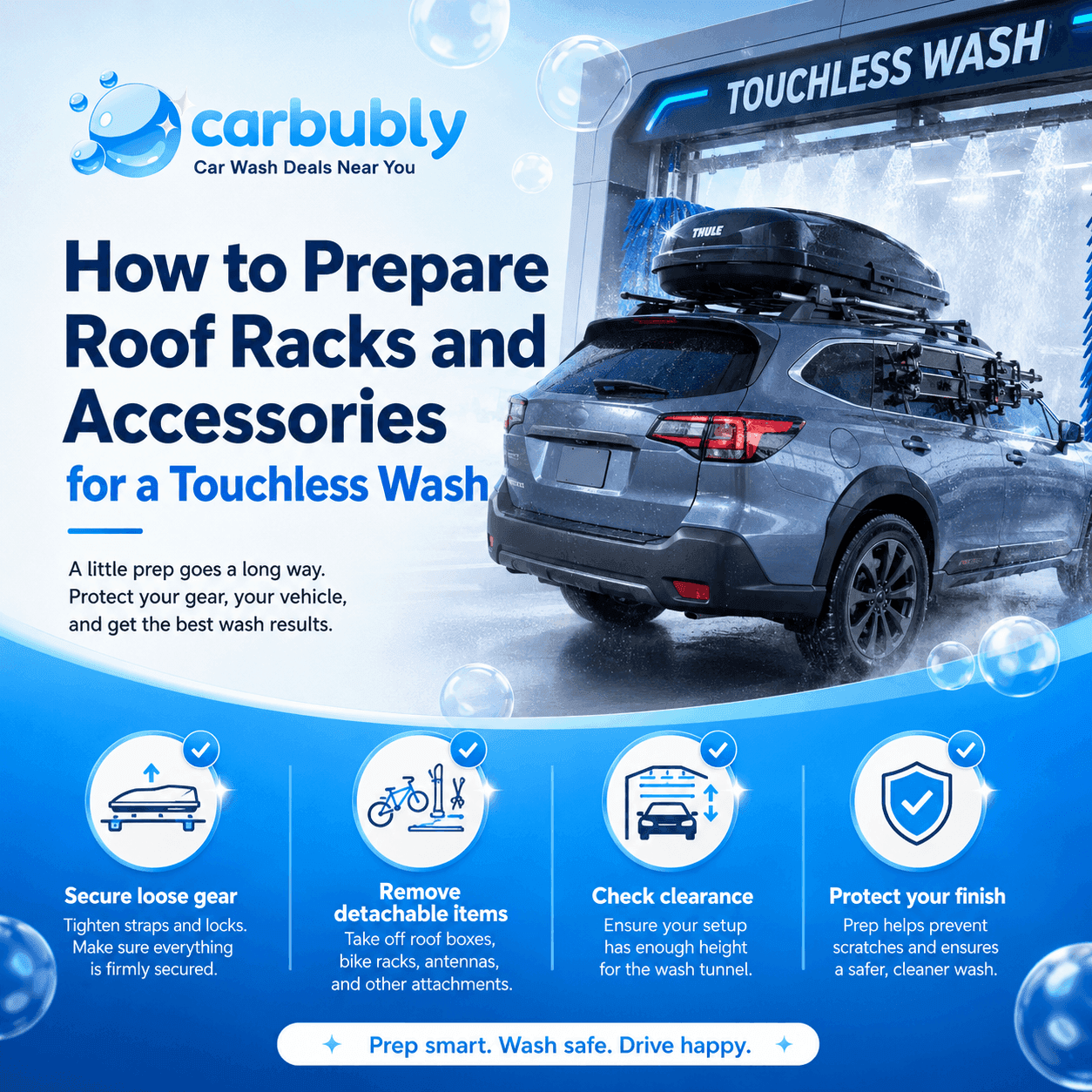
How to Prepare Roof Racks and Accessories for a Touchless Wash starts with checking every mounted item, removing anything loose or unnecessary, confirming height clearance, and choosing a wash method that fits your vehicle setup.
That quick check matters more than many drivers realize. A Touchless Wash does not use brushes or cloth strips, but it still uses high-pressure water, detergents, rinse cycles, and air drying. Roof racks, crossbars, cargo boxes, bike mounts, kayak carriers, ski racks, light bars, antennas, window visors, hitch accessories, and aftermarket trim can all change how water moves around the vehicle.
Most of the time, preparing your vehicle is simple. You do not need to overthink it. But you do need to pause before driving into the wash bay. Look at the roof, check the attachments, remove loose items, and read the wash rules. A little preparation can help you avoid damage, leaks, missed spots, and awkward problems at the entrance.
This guide explains how to prepare roof racks and accessories, when a Touchless Wash makes sense, when to choose hand washing or full-service detailing instead, and how Carbubly helps drivers compare Exclusive car wash deals, only on Carbubly.
What Does It Mean to Prepare Roof Racks and Accessories for a Touchless Wash?
Preparing roof racks and accessories for a Touchless Wash means checking any item attached to the outside of your vehicle before entering the wash. The goal is to make sure nothing is loose, oversized, fragile, removable, or likely to interfere with the wash equipment.
A Touchless Wash is a no-brush exterior wash. It usually uses:
Pre-soak detergent
High-pressure water jets
Rinse cycles
Optional protectants
Spot-free rinse
Air drying
Because nothing physically scrubs the vehicle, touchless washing can be useful for light dust, pollen, rain spots, and mild road film. But roof-mounted accessories can affect the process. Water may bounce around crossbars. Soap can collect under cargo boxes. Air dryers may rattle loose attachments. Some accessories may push the vehicle above the wash’s height limit.
That is why preparation matters.
Common accessories to check include:
Roof racks
Crossbars
Cargo boxes
Bike racks
Ski and snowboard racks
Kayak or paddleboard carriers
Awning mounts
Light bars
Antenna extensions
Hitch cargo carriers
Aftermarket spoilers
Window visors
Magnetic signs
Temporary decals
Clip-on mirrors
The best rule is simple: if it is removable, loose, tall, fragile, or not needed for the wash, check it carefully or take it off.
Why Does Roof Rack Prep Matter Before a Touchless Wash?
Roof rack prep matters because a Touchless Wash still uses force. No brushes touch the paint, but high-pressure water and strong air dryers can still move loose items, shake accessories, push water into gaps, or expose weak mounting points.
It is also about clearance. Many car wash bays have height limits, width limits, and restrictions on roof accessories, cargo boxes, ladders, bike racks, or loose equipment. If your vehicle is too tall or has attachments that do not fit, the wash may not be safe to enter.
There is a bigger road-safety habit here too. Roof racks and accessories should be secure before driving anywhere, not just before washing. NHTSA’s crash data resources exist to help track traffic safety issues of all severities, including risks related to roadway hazards and vehicle operation. For everyday drivers, the practical takeaway is simple: mounted equipment should be checked regularly, especially after trips, weather, off-road use, or frequent loading.
Car washing also connects to environmental care. The EPA says outdoor vehicle washing can send detergent-rich water into storm drains, and that wash water may contain nutrients, metals, and hydrocarbons in its vehicle washing stormwater guidance. Professional wash providers may have better systems or procedures for handling wash water than driveway washing, depending on the facility and local setup.
So preparation is not just about protecting the accessory. It is about choosing a wash that fits the vehicle, the equipment, and the situation.
What Do the Statistics Say About Vehicle Washing and Preparation?
Statistics are useful because they show why vehicle care is not a small topic.
The U.S. has hundreds of millions of registered vehicles
The Federal Highway Administration reported 284,614,269 registered motor vehicles in the U.S. in 2023 in its State Motor-Vehicle Registrations table. That number gives scale. Millions of drivers use cars, trucks, SUVs, EVs, vans, and work vehicles that may carry racks, boxes, ladders, cargo trays, or other accessories.
A standard wash may work for a standard car. But not every vehicle is standard. That is why accessory prep matters.
Wash water can carry pollutants
The EPA explains that outdoor washing can send detergent-rich water into storm drains, and that the water may contain nutrients, metals, and hydrocarbons. The EPA also notes in its vehicle and equipment washing guidance that vehicle washing can generate wastewater with sediment, detergents, oils, grease, and heavy metals.
For drivers, this means washing at a professional facility may be a better choice than rinsing at home in some situations, depending on the provider and local runoff setup.
Touchless washing has benefits and limits
Consumer Reports explains that touchless washes avoid brushes but may not always clean as thoroughly in its guide on car cleaning choices and touchless wash limits. That matters when your vehicle has roof racks or cargo accessories because dirt can hide around mounting feet, under crossbars, and behind brackets.
Touchless washing can be helpful, but it may not clean every tight area.
EVs and Teslas need owner-manual awareness
Tesla’s Model Y car wash guidance explains Car Wash Mode and vehicle cleaning precautions. For EV owners, this is a reminder to follow manufacturer guidance before automatic washes, especially when accessories are attached.
How Does a Touchless Wash Work with Roof Racks?
A Touchless Wash works by spraying the vehicle from different angles. It does not scrub around your accessories. That is both the benefit and the limitation.
Here is what usually happens:
First, the system applies water or pre-soak to loosen dirt.
Next, detergent helps break down light grime.
Then high-pressure water jets rinse the vehicle.
Some systems apply a protectant or spot-free rinse.
Finally, air dryers blow water off the vehicle.
Roof racks can interrupt that process. Crossbars can block spray angles. Cargo boxes can create shadowed areas where soap or water sits. Bike racks or ski attachments can collect detergent in small corners. Air dryers may make loose straps or rubber covers flap.
This does not mean you can never use a Touchless Wash with roof racks. It means you should inspect the setup first and understand that results may be uneven.
Should You Remove Roof Racks Before a Touchless Wash?
Remove roof racks or accessories before a Touchless Wash when they are easy to remove, not needed, loose, tall, fragile, or restricted by the wash provider.
You should strongly consider removing:
Cargo boxes
Bike carriers
Kayak carriers
Paddleboard attachments
Ski racks
Loose straps
Temporary cargo mounts
Aftermarket accessories with weak mounting points
Magnetic signs
Clip-on accessories
You may be able to leave fixed crossbars in place if they are secure, within the wash height limit, and allowed by the provider. Still, check the rules before entering.
A good way to decide is to ask: “Would I be comfortable driving at highway speed with this attached today?” If the answer is no, do not take it through a wash.
When Is a Touchless Wash the Right Choice?
A Touchless Wash is a good choice when your vehicle is lightly dirty and your accessories are secure, low-profile, and allowed by the wash provider.
Touchless works well for:
Light dust
Pollen
Rain spots
Mild road film
Fresh residue
Maintenance between deeper washes
Vehicles with dark paint
EVs and Teslas, when owner guidance is followed
Cars with ceramic coating or paint protection film, if chemicals are compatible
Touchless washing is not usually best for heavy mud, old bug splatter, sap, dirty wheels, or grime hiding under rack mounts. It also will not clean inside a cargo box, under rack feet, or around every bracket.
You can explore touchless car wash services when your vehicle needs a fast, lower-contact exterior clean.
When Should You Choose Hand Washing Instead?
Choose hand washing when roof racks or accessories create tight areas that need more attention. A person can clean around rack feet, under crossbars, near brackets, and along roof edges more carefully than a touchless spray system.
Hand washing is usually better for:
Dirt under rack mounts
Bugs on front edges
Sap near roofline
Mud around accessories
Dirty wheels
Lower-panel grime
Vehicles with fragile aftermarket parts
Drivers who want a closer inspection
A good hand wash depends on technique. Clean mitts, car-safe soap, separate wheel tools, and clean microfiber towels matter. You can compare hand car wash services when your vehicle needs more careful exterior attention.
When Is Full-Service Detailing Better?
Full-service detailing is better when the vehicle needs more than exterior spray cleaning.
Choose detailing when you have:
Interior crumbs
Pet hair
Dirty mats
Seat stains
Odors
Sticky cup holders
Glass haze
Cargo-area mess
Water spots
Wheel grime
Months of buildup
Roof racks and accessories often belong to people who use their vehicles actively: families, road-trippers, outdoor drivers, cyclists, skiers, campers, contractors, and pet owners. If the inside is messy too, a Touchless Wash will not solve the whole problem.
You can book full-service car detailing when your vehicle needs a deeper reset.
How to Choose the Best Wash Option
Best for budget
Choose a Touchless Wash when your vehicle is lightly dirty and your roof accessories are secure, low-profile, and allowed by the wash provider.
Budget tip: do not pay for full detailing when you only need light exterior maintenance. But do not choose the cheapest wash if your vehicle has complicated roof accessories or heavy grime.
Best for convenience
Choose a wash near your normal routine. A provider near home, work, school, the gym, or grocery stores is often more useful than a cheaper wash far away.
Drivers can compare local options such as car wash deals in Sacramento, car wash deals in Folsom, car wash deals in Roseville, car wash deals in Citrus Heights, car wash deals in Elk Grove, car wash deals in Rancho Cordova, car wash deals in Davis, and car wash deals in West Sacramento.
Best for protection and detailing
Choose hand washing or detailing when your vehicle has roof-mounted accessories, paint protection film, ceramic coating, matte finish, vinyl wrap, aftermarket trim, or areas that need careful attention.
For Tesla and EV owners, review manufacturer guidance and confirm the wash method before entering. You can review Tesla’s car wash guidance before using an automatic wash.
Common Mistakes to Avoid
Forgetting height clearance
Cargo boxes, bike mounts, and lifted vehicles may exceed wash limits. Always check before entering.
Leaving loose straps attached
Loose straps can flap under water pressure or air drying. Remove or secure them.
Assuming touchless means risk-free
Touchless means no brushes. It does not mean every accessory is safe.
Ignoring provider rules
Some washes do not allow certain racks, cargo boxes, or aftermarket accessories. Read posted signs and deal details.
Expecting the roof to come out perfect
Crossbars, boxes, and brackets can block spray. Touchless may leave missed spots around accessories.
Dry wiping leftover dirt
If grime remains around rack feet or roof edges, do not rub it dry. Use a proper hand wash or detail.
Skipping EV prep
If you drive a Tesla or EV, close windows, secure the charge port, remove loose accessories, and follow the owner manual.
Where Carbubly Fits Naturally
Carbubly is a marketplace for car wash deals that helps drivers discover, compare, purchase, and redeem offers from trusted local car wash and detailing providers.
Carbubly is not a car wash operator. It does not personally wash vehicles. Instead, it connects drivers with local providers offering services such as touchless car wash, hand car wash, express wash, mobile detailing, and full-service detailing.
Start with Carbubly when you want to compare touchless wash deals, affordable car wash options, trusted car wash services, and local car wash providers. You can also view Carbubly on Google Maps for local trust context.
Carbubly helps drivers compare service details before choosing. That matters when your vehicle has roof racks, cargo boxes, bike mounts, or accessories that may not fit every wash.
For Local Car Wash Providers
Drivers with roof racks and accessories need clear information before they arrive. If you operate a touchless wash, hand wash, express wash, mobile detailing service, or full-service detailing business, your listing should explain accessory rules clearly.
A strong provider listing should include:
Height limits
Accessory restrictions
Whether roof racks are allowed
Whether cargo boxes are allowed
Whether bike racks or hitch racks must be removed
What the wash includes
Whether hand washing is available
Whether detailing is available
Redemption instructions
Extra fees or restrictions
Clear information helps customers choose with confidence and prevents awkward problems at the wash entrance.
Final Tips Before Choosing a Touchless Wash
Before entering a Touchless Wash, do one final walkaround.
Check the roof.
Look at crossbars.
Remove loose straps.
Remove temporary accessories.
Confirm cargo box clearance.
Check antennas.
Look for loose trim.
Read the posted wash rules.
Follow EV or Tesla guidance if relevant.
If anything looks loose, too tall, fragile, or questionable, do not enter. Choose hand washing or detailing instead.
Conclusion: How to Prepare Roof Racks and Accessories for a Touchless Wash
How to Prepare Roof Racks and Accessories for a Touchless Wash is mostly about slowing down for a quick inspection before you enter the wash. Check every attachment, remove loose or unnecessary items, confirm height clearance, follow provider rules, and choose a different service if the setup does not look right.
A Touchless Wash can be a smart choice for light dust, pollen, rain spots, and mild road film when your accessories are secure and allowed. Hand washing is better when racks, brackets, or roof edges need careful attention. Full-service detailing is better when the interior or exterior needs a deeper reset.
Carbubly helps drivers compare touchless, hand wash, express wash, mobile detailing, and detailing offers from trusted local providers. Visit Carbubly to compare nearby car wash deals and choose the wash that fits your vehicle, accessories, and schedule.
FAQs About How to Prepare Roof Racks and Accessories for a Touchless Wash
1. How do I prepare roof racks and accessories for a Touchless Wash?
Prepare roof racks and accessories for a Touchless Wash by checking that everything is tight, removing loose straps or removable attachments, confirming height clearance, and reading the wash provider’s rules before entering.
2. Can I go through a Touchless Wash with roof racks?
Sometimes, yes. Fixed roof racks may be allowed if they are secure and within the wash height limit. Always check the provider’s restrictions before entering.
3. Should I remove my cargo box before a Touchless Wash?
Yes, remove a cargo box if possible. Cargo boxes add height, can trap soap or water, and may be restricted by the wash provider.
4. Can bike racks go through a Touchless Wash?
It is usually better to remove bike racks before a Touchless Wash. They can block spray, collect detergent, or exceed wash restrictions.
5. Will a Touchless Wash clean under roof racks?
Not always. Crossbars and rack feet can block spray, so dirt may remain under or around mounted hardware.
6. Is a Touchless Wash safer than a brush wash for accessories?
A Touchless Wash avoids brushes, but it still uses high-pressure water and air dryers. Loose or fragile accessories can still be a problem.
7. What should I do if my rack is loose?
Do not enter the wash. Tighten the rack according to the manufacturer’s instructions or remove it before washing.
8. Is hand washing better for vehicles with accessories?
Hand washing is often better when accessories create tight areas, dirty roof edges, or spots that need more careful cleaning.
9. Should Tesla owners remove roof accessories before washing?
Tesla owners should follow their owner manual and provider instructions. Remove loose or unnecessary accessories, secure the charge port, close windows, and use wash settings when appropriate.
10. Where can I compare Touchless Wash deals?
You can compare Touchless Wash deals on Carbubly, a marketplace that helps drivers discover, compare, purchase, and redeem offers from trusted local car wash and detailing providers.