


Could Sacramento Become California’s Next Autonomous Mobility Hub?
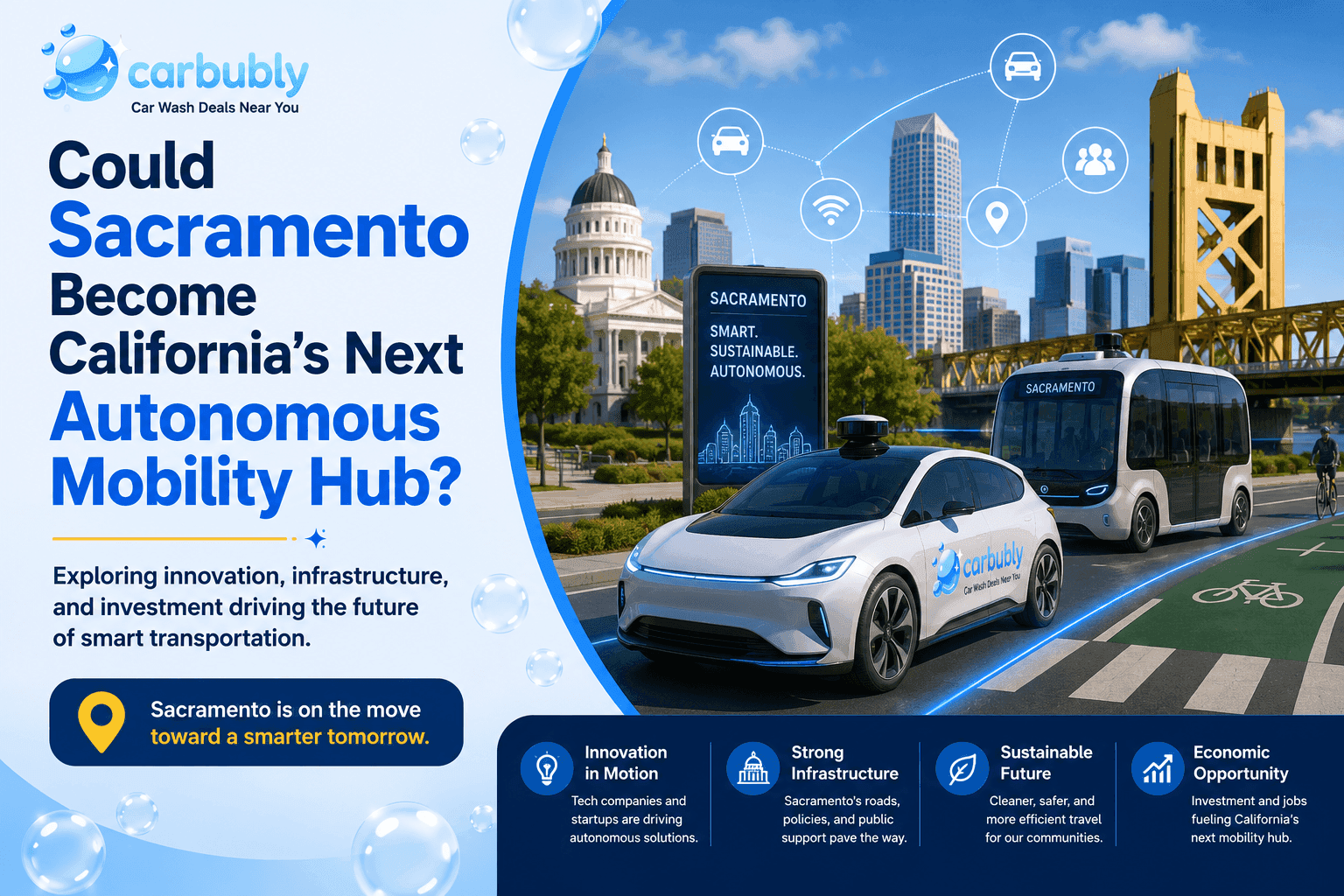
An autonomous mobility hub Sacramento future is possible if the region combines safe AV testing, clear regulations, strong road infrastructure, charging access, fleet maintenance, public trust, and practical support services like cleaning, detailing, and vehicle readiness.
Sacramento already has several ingredients that make the question worth asking. It is California’s capital, sits near major highways, connects to suburbs and regional job centers, and has a mix of commuters, state workers, students, families, delivery traffic, public transit users, and local businesses. It is also close enough to the Bay Area to learn from the state’s most active autonomous vehicle markets, but different enough to require its own approach.
Still, becoming an autonomous mobility hub does not happen just because robotaxis or self-driving shuttles sound exciting. A real hub needs safety planning, permits, charging, curb management, passenger trust, emergency-response coordination, weather and road readiness, data transparency, and daily vehicle maintenance. Clean sensors, clear cameras, readable exterior surfaces, and well-kept fleets may become part of that future too.
That is where local vehicle care enters the conversation. Drivers and fleets still need clean, reliable, presentable vehicles, whether the car is human-driven, driver-assisted, electric, shared, or eventually autonomous. For everyday drivers comparing Exclusive car wash deals, only on Carbubly., the same idea applies: future mobility still depends on practical local services.
Key Takeaways
Sacramento could become a stronger autonomous mobility hub if safety, regulation, infrastructure, charging, maintenance, and public trust develop together.
Autonomous mobility does not only mean robotaxis; it can include shuttles, delivery vehicles, connected fleets, transit support, and driver-assistance technology.
Clean sensors, cameras, glass, lights, and vehicle exteriors may become more important as vehicles rely more on automation and visibility systems.
Sacramento’s location, road network, state-government role, and regional connections make it a serious candidate for future AV activity.
Local car wash and detailing providers could support future autonomous fleets through routine cleaning, sensor-area care, interior resets, and EV-friendly service options.
Carbubly is a marketplace for car wash deals that helps drivers compare trusted local car wash and detailing providers, not a car wash operator.
What Is an Autonomous Mobility Hub?
An autonomous mobility hub is a city or region where self-driving, driver-assisted, connected, electric, and shared mobility systems can operate safely and practically. It is not just one robotaxi service. It is a larger ecosystem.
An autonomous mobility hub may include:
Autonomous vehicle testing
Driverless ride-hailing, where approved
Self-driving shuttles
Connected transit systems
Delivery robots or autonomous delivery vehicles
EV charging and fleet depots
Maintenance and cleaning facilities
Smart curb management
Digital booking and routing systems
Public safety coordination
Clear local and state rules
Passenger education
Data reporting and accountability
For Sacramento, the phrase “autonomous mobility hub” should be understood carefully. It does not mean every car drives itself. It means the region could become a place where new mobility systems are tested, regulated, supported, and used in real-world conditions.
The National Highway Traffic Safety Administration explains that automated vehicle technology ranges from driver-assistance features to more advanced automated driving systems. NHTSA’s automated vehicle safety overview also emphasizes that these technologies are still developing and must be evaluated with safety in mind.
Why Sacramento Could Be a Serious Candidate
Sacramento has a few natural advantages. It is not as dense as San Francisco, but it is not a small town either. It has highways, government offices, suburbs, business districts, residential neighborhoods, transit corridors, universities nearby, hospitals, shopping centers, and regional travel patterns.
That mix matters because autonomous mobility needs varied but manageable conditions. A city that only has one type of trip is less useful as a proving ground. Sacramento has many trip types:
Downtown office travel
State government commuting
Airport trips
Suburban shopping routes
School and family trips
Medical appointments
University-area travel
Delivery routes
Event traffic
Regional trips to Roseville, Citrus Heights, Rancho Cordova, Folsom, Elk Grove, Davis, and West Sacramento
The City of Sacramento also has a public-facing page on autonomous vehicles in Sacramento, which points residents toward the California DMV’s role in AV testing and deployment. That local government context matters because cities need to understand how AVs affect streets, curbs, transit, parking, and public safety.
Sacramento does not need to copy San Francisco or Los Angeles. It can become useful in a different way: as a practical regional mobility hub where technology must work for commuters, families, fleets, and suburban routes.
What Do the Statistics Say?
A few trusted sources help explain why the autonomous mobility hub Sacramento question is realistic, but not guaranteed.
Sacramento has real urban scale. The U.S. Census Bureau’s Sacramento QuickFacts page provides current city-level population, housing, and commute context. For AV planning, the key point is that Sacramento is large enough to have meaningful transportation demand, but still has regional routes that may be easier to study than the densest urban cores.
California already has an AV regulatory structure. The California DMV says it administers the state’s Autonomous Vehicles Program and issues permits to manufacturers that test and deploy autonomous vehicles on California public roads. Sacramento’s future as a hub would need to fit inside those state rules.
AV testing permissions are statewide, but deployment is not automatic. The DMV’s autonomous vehicle permit holder page explains that manufacturers with a testing permit and safety driver are authorized to test on public roads within California. That does not mean every city has active service, but it shows the regulatory framework already exists.
The vehicle market is massive. The Federal Highway Administration reported 284,614,269 registered motor vehicles in the U.S. in 2023 in its State Motor-Vehicle Registrations table. Future autonomous mobility will have to coexist with a large number of human-driven cars, trucks, SUVs, vans, Teslas, EVs, work vehicles, and family vehicles.
Vehicle cleaning has environmental considerations. The EPA explains in its vehicle maintenance and washing stormwater guidance that vehicle washing can release pollutants such as hydrocarbons and heavy metals if handled improperly. If autonomous fleets grow, fleet cleaning and maintenance practices will matter even more.
The takeaway: Sacramento has potential, but a true hub requires more than vehicles. It needs governance, infrastructure, services, maintenance, and trust.
How Would an Autonomous Mobility Hub Work?
An autonomous mobility hub would likely develop in stages.
Stage 1: Testing and limited pilots
Early activity may involve supervised testing, fixed-route shuttles, delivery pilots, or limited operating areas. These systems would likely focus on specific roads, neighborhoods, campuses, business districts, or controlled service areas.
The goal would be to learn:
Which roads work well
Where AVs struggle
How weather affects performance
How passengers respond
How emergency vehicles interact with AVs
How curb pickup and drop-off should work
How charging and cleaning fit into daily operations
Stage 2: Fleet operations and service corridors
If early systems work, the next step could be defined corridors. Sacramento’s regional layout may be useful here. AV services could eventually connect downtown, employment centers, transit hubs, medical areas, shopping centers, universities, airport routes, and nearby suburbs.
This stage would require:
Charging access
Fleet storage
Vehicle cleaning
Maintenance teams
Data reporting
Local operations staff
Clear public instructions
Insurance and liability planning
Emergency response protocols
Stage 3: Integrated mobility
A mature hub would not treat AVs as a novelty. It would connect them with daily life.
That could include:
Transit connections
Airport trips
First-mile and last-mile service
Shared mobility
Accessible rides
Delivery logistics
Fleet cleaning and detailing schedules
Smart booking systems
EV charging coordination
Local business partnerships
In that future, car wash and detailing providers may support not just individual drivers, but vehicle fleets that need consistent cleaning and interior upkeep.
Why Clean Vehicles Matter for Autonomous Mobility
A clean vehicle is not only about appearance. For autonomous and highly connected vehicles, exterior cleanliness can affect visibility, passenger trust, and vehicle readiness.
Autonomous and driver-assistance systems may use:
Cameras
Radar
Lidar
Ultrasonic sensors
Exterior lights
Windshields
Mirrors
Glass roof areas
Body-mounted sensors
Software-based monitoring
Dirt, bugs, road film, pollen, rain spots, mud, and grime can collect around these areas. That does not mean a dirty car becomes unsafe automatically. It does mean vehicle cleanliness may become a bigger maintenance topic as fleets rely more on sensors and cameras.
This is especially relevant for:
Robotaxis
Shared EV fleets
Delivery vehicles
Rideshare vehicles
Autonomous shuttles
Tesla vehicles
EV fleets
High-use commuter vehicles
A vehicle used many hours per day may need cleaning more often than a personal car parked in a garage. That creates a natural connection between autonomous mobility and local vehicle-care services.
Service Comparison: What Cleaning Options Would Future Fleets Need?
Autonomous mobility would not rely on one type of cleaning. Different situations need different services.
Touchless car wash: Useful for quick exterior cleaning with lower-contact wash preferences. Drivers and fleets can explore touchless car wash services when brush contact is a concern.
Hand car wash: Useful when vehicles have bugs, road film, dirty wheels, sensor-area grime, bird droppings, or areas that need human attention. A fleet or driver can compare hand car wash services when automatic cleaning may not be enough.
Full-service detailing: Useful when passenger interiors matter, especially for shared vehicles, rideshare cars, and family vehicles. Drivers can book full-service car detailing when seats, mats, glass, cup holders, odors, pet hair, or cargo areas need a deeper reset.
Mobile detailing: Useful when vehicles need cleaning at a depot, office, home, or approved parking location.
Express car wash: Useful for fast exterior maintenance between deeper services.
Future mobility hubs will need all of these options, not just one.
What Sacramento Would Need to Become a Strong AV Hub
Sacramento’s potential depends on several practical factors.
Clear regulation and public coordination
AV testing and deployment must follow state rules. The California DMV regulates AV testing and deployment, while cities manage local street impacts, curbs, public communication, and mobility planning.
Sacramento would need coordination among:
California DMV
City transportation staff
Transit agencies
Emergency responders
AV companies
Local businesses
Community groups
Charging providers
Fleet operators
Maintenance and cleaning providers
Infrastructure that supports mixed traffic
Autonomous vehicles must share roads with human drivers, cyclists, pedestrians, buses, scooters, delivery vehicles, construction crews, and emergency responders.
Sacramento would need attention to:
Lane markings
Work-zone clarity
Pickup and drop-off zones
Curb space
Traffic signal reliability
Road maintenance
Construction communication
Transit connections
Safe school and pedestrian areas
Charging and fleet operations
Because many AVs are likely to be electric, charging access will matter. Fleets also need places to stage, inspect, clean, repair, and recharge vehicles.
A future hub would need:
EV charging hubs
Fleet depots
Maintenance bays
Cleaning stations
Interior reset areas
Safe parking
Data and dispatch systems
Service staff
Public trust
People need to understand how autonomous mobility works. Public trust is not built through hype. It is built through safe operations, clear rules, transparent communication, and reliable service.
Residents may ask:
Who is responsible if something goes wrong?
Where can AVs operate?
Can AVs stop for emergency vehicles?
How are disabled vehicles handled?
Are rides affordable?
Are vehicles clean?
Are interiors safe and comfortable?
How is data handled?
How do AVs interact with pedestrians and cyclists?
A real hub must answer these questions clearly.
How to Choose the Best Option for Today’s Drivers
Even if Sacramento becomes a stronger autonomous mobility hub, most drivers still need practical car wash decisions today.
Best for budget
Choose the most affordable service that fits the vehicle’s condition.
Good budget choices may include:
Express wash for light dust
Touchless wash for lower-contact exterior cleaning
Hand wash for bugs, wheels, and lower panels
Interior add-ons when the outside is already clean
Full-service detailing only when the vehicle needs a deeper reset
Best for convenience
Choose providers near your real route. Drivers can compare car wash deals in Sacramento first. If your schedule crosses the region, you may also compare car wash deals in Citrus Heights, car wash deals in Roseville, car wash deals in Rancho Cordova, car wash deals in Folsom, car wash deals in Elk Grove, car wash deals in Davis, and car wash deals in West Sacramento.
Convenience is not only distance. It is service fit, timing, package clarity, and vehicle compatibility.
Best for protection and detailing
Choose more careful service when the vehicle has:
Cameras or sensors
Tesla or EV-specific needs
Ceramic coating
Paint protection film
Vinyl wrap
Dark paint
Heavy bugs
Dirty wheels
Interior odors
Pet hair
Passenger wear
High daily usage
For Tesla owners, review Tesla’s car wash guidance before automatic wash situations. Follow the current owner manual and provider instructions.
Common Mistakes to Avoid When Discussing Autonomous Mobility
Assuming autonomous means fully driverless everywhere. Automation levels and operating areas vary.
Ignoring regulation. AV testing and deployment must fit state rules and local street realities.
Forgetting mixed traffic. AVs must operate around human drivers, cyclists, pedestrians, buses, and emergency vehicles.
Overlooking cleaning and maintenance. Fleets need regular exterior and interior care.
Treating Sacramento like San Francisco. Sacramento has different roads, neighborhoods, commute patterns, and regional needs.
Assuming technology alone solves mobility. A useful hub also needs access, affordability, safety, charging, maintenance, and public trust.
Ignoring local businesses. Car wash providers, detailers, charging operators, repair shops, and fleet-support services could all play roles.
Making unsupported predictions. Sacramento could grow as a hub, but timelines depend on regulation, investment, technology, and public adoption.
Forgetting passenger experience. Clean, comfortable, well-maintained vehicles matter.
Skipping environmental practices. Fleet cleaning should account for water use and runoff.
Where Carbubly Fits Naturally
Carbubly is a marketplace for car wash deals that helps drivers discover, compare, purchase, and redeem offers from trusted local car wash and detailing providers.
Carbubly is not a car wash operator. It does not personally wash vehicles. Instead, it helps drivers compare local providers offering hand car wash, touchless car wash, express wash, mobile detailing, full-service detailing, Tesla car wash options, EV-safe car wash preferences, and other vehicle-cleaning services.
Start with Carbubly when you want to compare affordable car wash options, trusted car wash services, local car wash providers, and car wash savings. You can also view Carbubly on Google Maps for local trust context.
In a future autonomous mobility hub Sacramento scenario, vehicle care could become even more important. Shared, connected, and high-use vehicles may need reliable cleaning, interior resets, wheel cleaning, sensor-area attention, and EV-aware service options. Carbubly can help drivers and local customers compare providers today while the future of mobility continues to develop.
Final Tips Before Calling Sacramento an Autonomous Mobility Hub
Use this checklist when evaluating the idea:
Does Sacramento have clear local mobility planning?
Are AV companies permitted under California rules?
Are service areas clearly defined?
Are emergency-response procedures in place?
Are roads and lane markings maintained well enough?
Are charging and fleet facilities available?
Are vehicle cleaning and maintenance systems planned?
Are pickup and drop-off zones managed?
Are residents informed?
Are safety results transparent?
Are providers ready for EV and sensor-heavy vehicles?
Are local businesses included in the mobility ecosystem?
Is the system useful for everyday people, not just technology demos?
Sacramento could become an important autonomous mobility market, but only if the practical details are handled well.
Conclusion: Autonomous Mobility Hub Sacramento
An autonomous mobility hub Sacramento future is realistic to discuss, but it should be approached carefully. Sacramento has strong ingredients: regional roads, state-government presence, suburban connections, commuter demand, EV growth, and proximity to California’s wider AV ecosystem. But a true hub would require safe deployment, clear regulation, charging access, public trust, emergency coordination, fleet operations, and reliable vehicle care.
Autonomous mobility is not only about cars driving themselves. It is about the full system around those vehicles: streets, software, charging, cleaning, maintenance, booking, riders, businesses, and local rules. As vehicles become more connected and sensor-dependent, clean exteriors, clear glass, maintained interiors, and trusted local service providers may become more important.
Carbubly helps drivers compare car wash and detailing deals from trusted local providers today. Visit Carbubly to compare nearby options and stay connected to the future of cleaner, smarter vehicle care.
FAQs About Autonomous Mobility Hub Sacramento
1. What is an autonomous mobility hub Sacramento?
An autonomous mobility hub Sacramento would be a regional ecosystem where autonomous vehicles, connected mobility, EV charging, fleet operations, public safety coordination, and local support services work together.
2. Could Sacramento become an autonomous mobility hub?
Yes, Sacramento could become an autonomous mobility hub Sacramento candidate if safety rules, AV permits, infrastructure, charging, maintenance, and public trust develop together.
3. Does Sacramento already have autonomous vehicles?
Sacramento has public information about autonomous vehicles and relies on California DMV rules for testing and deployment. Active commercial service depends on approved operators and permits.
4. Why would Sacramento be a good AV market?
Sacramento has commuter routes, state offices, highways, suburbs, regional travel demand, and nearby cities that could support future autonomous mobility use cases.
5. What would AV fleets need besides roads?
AV fleets would need charging, storage, software support, maintenance, cleaning, detailing, passenger support, safety protocols, and clear local operating rules.
6. Why does car washing matter for autonomous vehicles?
Autonomous and driver-assistance vehicles may rely on cameras, sensors, glass, lights, and exterior surfaces. Regular cleaning can support visibility, passenger trust, and fleet readiness.
7. Would autonomous vehicles use touchless car washes?
Some autonomous or EV fleets may prefer touchless washes for light exterior cleaning, but hand washing or detailing may be better for sensors, bugs, wheels, and interiors.
8. Could local car wash providers support AV fleets?
Yes. Local car wash and detailing providers could support future fleets with exterior cleaning, interior resets, sensor-area care, wheel cleaning, mobile detailing, and EV-aware service options.
9. What is the biggest challenge for Sacramento AV growth?
The biggest challenge is not one thing. Sacramento would need safety, public trust, regulation, infrastructure, charging, maintenance, emergency coordination, and useful service areas.
10. Where can Sacramento drivers compare car wash deals now?
Sacramento drivers can compare car wash deals on Carbubly, a marketplace that helps drivers discover, compare, purchase, and redeem offers from trusted local car wash and detailing providers.