


Autonomous Vehicles in Sacramento: What Is Actually Authorized Today
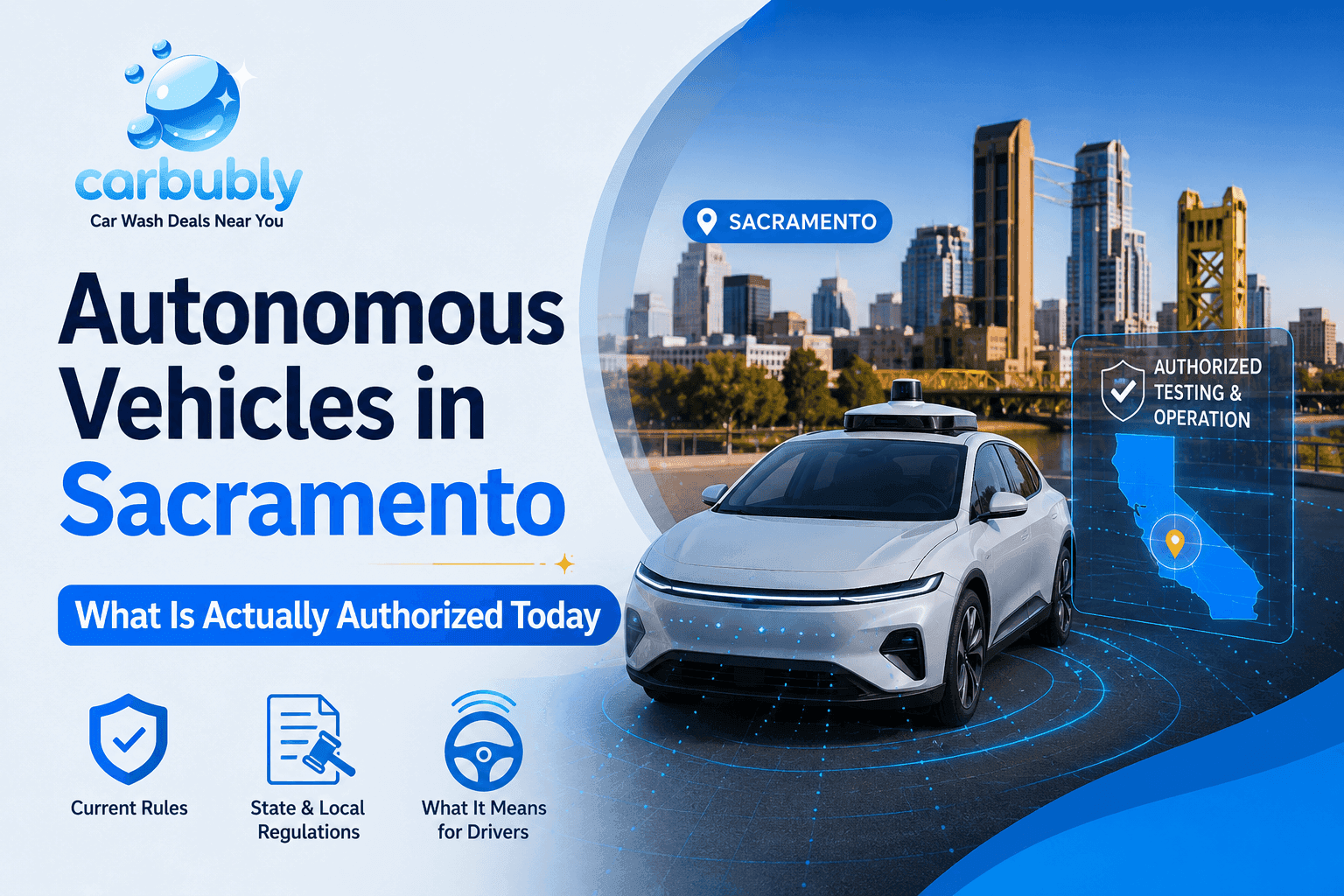
Autonomous vehicles Sacramento activity is authorized today only through California’s state-level autonomous vehicle permit system, meaning approved companies may test or deploy under specific DMV rules, but Sacramento is not automatically an open, citywide robotaxi market for every self-driving vehicle.
That distinction matters. When people hear “autonomous vehicles,” they may picture driverless robotaxis picking up passengers anywhere in the city, Tesla cars driving themselves without supervision, or fleets operating like regular rideshare services. The reality is more controlled. In California, authorization depends on permit type, operating conditions, vehicle category, approved service areas, safety reporting, and, for passenger service, additional rules that may involve the California Public Utilities Commission.
Sacramento has public information about autonomous vehicles, and the city points residents toward state-level authorization and reporting resources. But understanding what is actually allowed today takes a little unpacking.
This guide explains what autonomous vehicles Sacramento rules mean in practical terms, how California permits work, what residents should and should not assume, and why vehicle care still matters as cars become more connected, electric, sensor-heavy, and software-driven. For everyday drivers comparing “Exclusive car wash deals, only on Carbubly.”, the same lesson applies: look beyond the headline and check what is really included.
Key Takeaways
Autonomous vehicles in Sacramento are governed mainly by California DMV rules, not a simple citywide permission slip.
California DMV authorizes AV activity through categories such as testing with a safety driver, driverless testing, and deployment.
A company with a testing-with-driver permit may be authorized to test on public roads in California, but driverless testing and deployment have specific approved conditions.
Robotaxi passenger service can involve additional regulatory layers, including CPUC rules.
Sacramento residents should check official DMV and city sources before assuming a company is authorized to operate driverless service.
Future AV fleets may increase demand for clean cameras, sensors, glass, interiors, EV-safe car wash options, mobile detailing, and trusted local car wash providers.
What Does “Authorized” Mean for Autonomous Vehicles Sacramento?
When discussing autonomous vehicles Sacramento, “authorized” means a company or manufacturer has permission from the proper California regulatory body to test, deploy, or operate autonomous vehicles under defined rules. It does not mean every self-driving feature is allowed everywhere, and it does not mean every vehicle branded as “autonomous” can operate without a human driver.
California DMV explains that it authorizes manufacturers to test and deploy autonomous vehicles under permit categories that include testing with a safety driver, driverless testing, and deployment. The DMV’s Autonomous Vehicles Program notes that each category has specific approved locations, operating conditions, and speed limits.
That means there are different levels of authorization:
Testing with a safety driver: A permitted manufacturer tests AV technology with a trained human driver inside the vehicle.
Driverless testing: A permitted manufacturer tests without a human safety driver, but only under approved conditions.
Deployment: A permitted manufacturer operates autonomous vehicles for public use or commercial service under approved rules.
Passenger service: Robotaxi-style rides may also involve CPUC authorization, depending on the service model.
Consumer driver assistance: A private car with driver-assistance features is not the same as a permitted driverless robotaxi.
For Sacramento drivers, the main point is simple: do not assume a vehicle is legally operating as “driverless” just because it has advanced software, cameras, lidar, or a company logo.
Why This Topic Matters for Sacramento Drivers
This topic matters because Sacramento is part of California’s larger autonomous vehicle conversation. The city is the state capital, sits near major highways, and connects to suburbs such as Citrus Heights, Roseville, Rancho Cordova, Folsom, Elk Grove, Davis, and West Sacramento. It has commuter traffic, state workers, students, families, delivery routes, public transit, airport trips, and regional travel.
The City of Sacramento’s page on autonomous vehicles in Sacramento describes autonomous car services as robotaxis or driverless vehicles and points residents toward official state resources. The city also notes that autonomous vehicles, car share, rideshare, and taxis each have unique federal, state, and local regulations.
For residents, this creates practical questions:
Can driverless cars operate in Sacramento today?
Who gives permission?
Is a safety driver required?
Can a company offer paid rides?
Are AVs allowed on every street?
What happens if an AV blocks traffic or causes an incident?
How can residents report concerns?
What role does the city play?
How does this affect daily driving, parking, curbs, and local businesses?
These are not just technology questions. They are road safety, public trust, local business, and transportation planning questions.
What Do the Statistics Say?
A few trusted sources help explain why Sacramento residents should pay attention to AV authorization and vehicle-readiness details.
Vehicle activity is massive. The Federal Highway Administration reported 284,614,269 registered motor vehicles in the United States in 2023 in its State Motor-Vehicle Registrations table. Autonomous vehicles will have to share roads with a very large number of human-driven cars, SUVs, trucks, vans, work vehicles, Teslas, and EVs.
Sacramento has real city-scale transportation demand. The U.S. Census Bureau’s Sacramento QuickFacts page provides current population, household, and commute context. That matters because AV planning is not abstract; it affects real commuters, families, businesses, and neighborhoods.
California has a formal AV permit structure. The DMV’s autonomous vehicle permit holder page explains that a manufacturer with a permit to test with a safety driver is authorized to test on any public road within California. It also lists current permit holders and separates permit types.
Federal safety context still matters. NHTSA’s automated vehicle safety overview explains that automated driving systems may one day handle the whole driving task when people do not want to or cannot drive themselves, but the technology continues to evolve.
Vehicle washing and maintenance have environmental considerations. The EPA’s vehicle maintenance and washing stormwater guidance explains that vehicle washing can send detergent-rich water into storm drains and may involve pollutants such as nutrients, metals, and hydrocarbons. If AV fleets grow, responsible fleet cleaning and maintenance will matter.
The takeaway: Sacramento’s AV future depends on regulation, safety, infrastructure, public trust, and the practical services that keep vehicles road-ready.
How California Authorizes Autonomous Vehicles
California’s AV system is not based on a casual “yes” or “no.” It is built around permits.
Testing with a safety driver
This is the most basic public-road AV testing category. A company with this permit may test autonomous technology with a trained safety driver in the vehicle. According to the DMV’s permit holder page, a manufacturer with a testing-with-driver permit is authorized to test on any public road in California.
For Sacramento, that means a properly permitted company may be able to test with a safety driver on Sacramento public roads, as long as it follows the DMV rules. This does not mean the company can offer public driverless rides.
Driverless testing
Driverless testing is more advanced. It means the vehicle may operate without a human safety driver inside, but only if the manufacturer has the right permit and follows approved conditions.
Driverless testing may involve:
Specific operating areas
Speed limits
Weather limits
Remote assistance procedures
Reporting requirements
Safety plans
Insurance or financial responsibility
Emergency-response coordination
This is not the same as open public robotaxi service.
Deployment
Deployment is the category most people think about when they imagine autonomous vehicles serving the public. Deployment means the company is approved to operate AVs beyond testing under defined rules.
Deployment can still have limits. A company may be approved in some areas but not others. It may have conditions around routes, speeds, vehicle types, weather, fleet size, or reporting.
Passenger service and CPUC rules
If a company wants to carry passengers as a transportation service, DMV authorization may not be the only step. The City of Sacramento notes that the California Public Utilities Commission issues permits and regulates ride-hail service providers operating AVs. That means robotaxi service can involve both vehicle authorization and passenger-service regulation.
What Is Actually Authorized in Sacramento Today?
The most accurate answer is this: autonomous vehicles Sacramento activity is authorized only when a company has the proper California permit and follows its approved operating conditions. Sacramento itself is not a blanket authorization zone for every autonomous vehicle or robotaxi service.
Here is what residents should understand:
Testing with a safety driver may be allowed statewide for permitted manufacturers. The DMV says manufacturers with testing-with-driver permits are authorized to test on any public road in California.
Driverless testing is more limited. A company needs a driverless testing permit and must follow approved conditions.
Deployment is not the same as testing. Public or commercial AV service requires deployment authorization and may involve additional rules.
Robotaxi service may require CPUC involvement. Passenger service is regulated differently than technical testing.
City pages are not the final authorization list. Sacramento provides public information and links, but the DMV permit system is the main source for AV authorization.
A vehicle with driver-assistance software is not automatically a driverless AV. Many consumer systems still require a human driver to supervise and remain responsible.
For drivers, pedestrians, cyclists, and local businesses, the safest move is to check official sources before assuming what a vehicle is allowed to do.
How Can Residents Check AV Authorization?
Sacramento residents can use a simple process.
Start with the California DMV
The DMV’s Autonomous Vehicles Program is the main source for permit categories, regulations, deployment information, testing resources, reporting forms, and permit holders.
Check:
Permit category
Company name
Testing with driver
Driverless testing
Deployment authorization
Reporting requirements
Collision reporting
Public incident reporting
Updated regulations
Check Sacramento’s local AV page
The City of Sacramento’s autonomous vehicle information page gives local residents a starting point and points to DMV and CPUC resources.
This is useful because city operations matter. Even if the state authorizes AV testing or deployment, local streets still involve curbs, parking, emergency response, construction zones, events, schools, bike lanes, pedestrians, and transit operations.
Look for CPUC context for passenger service
If the question is about robotaxi rides, not just vehicle testing, look for CPUC authorization. A company may have DMV testing permission but not passenger-service deployment approval.
Avoid relying only on social media
Announcements, app screenshots, news headlines, and company marketing may not tell the whole regulatory story. Always check official authorization.
How Does This Affect Everyday Drivers?
Most Sacramento drivers will not interact with AV permits directly, but they may see more advanced vehicles on local roads over time. The important thing is to understand what to do around them.
Practical tips:
Treat AVs like any other road user.
Do not test, block, or harass an autonomous vehicle.
Give space if a vehicle appears stopped or confused.
Follow normal traffic laws.
Report unsafe incidents through official channels when appropriate.
Do not assume a vehicle is driverless just because it looks high-tech.
Do not assume all Teslas, EVs, or sensor-equipped cars are autonomous.
Be extra cautious around construction, emergency scenes, crosswalks, schools, and bike lanes.
AVs may be advanced, but they still operate in a human environment. Sacramento roads include pedestrians, cyclists, delivery drivers, transit vehicles, emergency responders, school traffic, and everyday commuters.
What Should Local Businesses Know?
Local businesses may eventually be affected by AV activity in several ways.
Potential business impacts include:
Robotaxi pickup and drop-off zones
Delivery vehicle access
Curb congestion
Parking changes
Fleet service demand
EV charging demand
Maintenance demand
Cleaning and detailing demand
Passenger comfort expectations
Local advertising and booking integrations
For car wash and detailing providers, autonomous vehicles could create new service needs. High-use vehicles may need frequent cleaning, sensor-area care, interior resets, and EV-aware wash options.
A future AV fleet may need:
Touchless car wash options
Hand car wash services
Full-service detailing
Mobile detailing
Interior cleaning
Wheel cleaning
Glass cleaning
Sensor-area care
Odor treatment
Pet hair or passenger-mess removal
EV-safe car wash procedures
This does not mean every provider must become an AV fleet center. It means local vehicle-care services may become more important as mobility becomes more connected and shared.
Service Comparison: Vehicle Care for AVs, EVs, and Daily Drivers
Autonomous mobility may sound futuristic, but the cleaning needs are familiar.
Touchless car wash: Useful for light exterior dirt and lower-contact washing. Drivers can explore touchless car wash services when avoiding brush contact is a priority.
Hand car wash: Useful for bugs, sap, dirty wheels, lower-panel grime, and areas that need careful human attention. Compare hand car wash services when an automatic wash may not be enough.
Full-service detailing: Useful when interiors matter, especially for rideshare cars, shared vehicles, family cars, and high-use EVs. You can book full-service car detailing when seats, mats, glass, cup holders, odors, stains, or cargo areas need deeper care.
Mobile detailing: Useful when the provider can clean the vehicle at an approved location, such as a home, office, fleet lot, or business parking area.
Express car wash: Useful for quick exterior maintenance when the vehicle is only lightly dirty.
For autonomous vehicles, clean cameras, glass, lights, and exterior surfaces may become especially important. For human-driven vehicles, the same services still help with comfort, visibility, appearance, and vehicle maintenance.
How to Choose the Best Option Today
Best for budget
Choose the least expensive service that actually solves the cleaning problem.
Good budget choices may include:
Express wash for light exterior dust
Touchless wash for lower-contact exterior cleaning
Hand wash for bugs, wheels, and lower panels
Interior add-ons when the outside is already clean
Full-service detailing only when deeper cleaning is needed
Do not pay for a full detail if your vehicle only needs a quick exterior refresh.
Best for convenience
Choose a provider that fits your real route, not just the closest map result.
Drivers can compare car wash deals in Sacramento. If your routine crosses nearby cities, you may also compare car wash deals in Citrus Heights, car wash deals in Roseville, car wash deals in Rancho Cordova, car wash deals in Folsom, car wash deals in Elk Grove, car wash deals in Davis, and car wash deals in West Sacramento.
Convenience is about timing, package fit, location, wait time, and whether the provider can handle your vehicle.
Best for protection and detailing
Choose more careful service when the vehicle has:
Cameras or sensors
Tesla or EV-specific needs
Ceramic coating
Paint protection film
Vinyl wrap
Dark paint
Heavy bugs
Dirty wheels
Pet hair
Interior stains
Odors
Shared passenger use
For Tesla owners, review Tesla’s car wash guidance before automatic wash situations. Follow the current owner manual and provider instructions.
Common Mistakes to Avoid
Assuming “autonomous” means driverless everywhere. Many systems still require human supervision or operate only under strict conditions.
Confusing testing with deployment. Testing permission is not the same as public robotaxi service.
Ignoring permit categories. Safety-driver testing, driverless testing, and deployment are different.
Assuming Sacramento controls everything alone. California DMV plays the central role in AV authorization.
Forgetting CPUC passenger-service rules. Robotaxi rides may involve additional regulation.
Trusting headlines more than official sources. Check DMV, city, and CPUC resources.
Assuming every EV is autonomous. EVs, Teslas, driver-assistance systems, and autonomous vehicles are related but not the same.
Overlooking emergency response. AVs must interact safely with police, fire, ambulance, construction crews, and blocked roads.
Ignoring vehicle maintenance. AVs and sensor-heavy vehicles still need cleaning, inspection, and detailing.
Making unsupported predictions. Sacramento’s AV future depends on permits, safety, public trust, infrastructure, and operator interest.
Where Carbubly Fits Naturally
Carbubly is a marketplace for car wash deals that helps drivers discover, compare, purchase, and redeem offers from trusted local car wash and detailing providers.
Carbubly is not a car wash operator. It does not personally wash vehicles. Instead, it helps drivers compare local providers offering hand car wash, touchless car wash, express wash, mobile detailing, full-service detailing, Tesla car wash options, EV-safe car wash preferences, and other vehicle-cleaning services.
Start with Carbubly when you want to compare affordable car wash options, trusted car wash services, local car wash providers, and car wash savings. You can also view Carbubly on Google Maps for local trust context.
As autonomous vehicles Sacramento activity evolves, vehicle care may become even more important. Shared vehicles, EV fleets, sensor-heavy cars, and high-use mobility services need clean exteriors, clear glass, maintained interiors, and trusted local providers.
Final Tips Before Believing an AV Claim in Sacramento
Use this checklist when you see a claim about autonomous vehicles Sacramento activity:
Check whether the company has a California DMV permit.
Confirm the permit category.
Separate safety-driver testing from driverless testing.
Separate testing from deployment.
Check whether passenger service is involved.
Look for CPUC authorization when rides are offered.
Check approved operating areas and conditions.
Use official DMV and city resources.
Be cautious with marketing claims.
Report unsafe incidents through official channels.
Remember that EVs and AVs are not the same.
Look for clear information before assuming public service is authorized.
A simple rule helps: ask who authorized it, under what permit, and for what use.
Conclusion: Autonomous Vehicles Sacramento
Autonomous vehicles Sacramento activity is real to discuss, but the authorized status depends on California’s permit system, not broad assumptions. Today, the California DMV is the key authority for AV testing and deployment, while passenger service may also involve CPUC rules. Sacramento provides local information and points residents toward official resources, but it does not turn the entire city into an open driverless testing zone by itself.
For residents, the practical answer is clear: permitted companies may test or operate only within the rules that apply to their permit type. Safety-driver testing, driverless testing, and deployment are different. Robotaxi passenger service is another layer. Always check official sources before assuming a vehicle is authorized for driverless public service.
As Sacramento’s transportation future evolves, vehicle readiness will continue to matter. Clean sensors, glass, cameras, lights, interiors, wheels, and EV-safe care can support both today’s drivers and tomorrow’s mobility systems. Visit Carbubly to compare trusted local car wash and detailing deals that fit your vehicle, schedule, and budget.
FAQs About Autonomous Vehicles Sacramento
1. What are autonomous vehicles Sacramento rules today?
Autonomous vehicles Sacramento activity is governed mainly by California DMV permits. Companies must have the right permit for testing with a driver, driverless testing, or deployment.
2. Are driverless cars allowed in Sacramento?
Driverless cars may only operate if the company has the proper California authorization and follows approved operating conditions. Sacramento is not automatically open to every driverless vehicle.
3. Who authorizes autonomous vehicles in Sacramento?
The California DMV authorizes autonomous vehicle testing and deployment. Passenger service may also involve the California Public Utilities Commission.
4. Can any AV company test in Sacramento?
A manufacturer with a DMV testing-with-driver permit is authorized to test on public roads in California, but it must follow state rules and reporting requirements.
5. Is testing the same as robotaxi service?
No. Testing is not the same as deployment or passenger service. Robotaxi service requires additional authorization and operating rules.
6. How can I check whether an AV company is authorized?
Check the California DMV Autonomous Vehicles Program and permit holder pages. For ride-hailing service, look for CPUC-related authorization as well.
7. Does a Tesla count as an autonomous vehicle in Sacramento?
A Tesla may have driver-assistance features, but that does not automatically make it an authorized driverless autonomous vehicle. Owners must follow current vehicle guidance and laws.
8. Why do autonomous vehicles need cleaning?
Autonomous and driver-assistance vehicles may rely on cameras, sensors, glass, lights, and exterior surfaces. Cleaning can support visibility, passenger trust, and vehicle readiness.
9. Could car wash providers support future AV fleets?
Yes. Local car wash and detailing providers could support AV and EV fleets with exterior cleaning, interior resets, sensor-area care, wheel cleaning, and mobile detailing.
10. Where can Sacramento drivers compare car wash deals now?
Sacramento drivers can compare car wash deals on Carbubly, a marketplace that helps drivers discover, compare, purchase, and redeem offers from trusted local car wash and detailing providers.