


Are Automated Car Washes Safe for ADAS Cars?
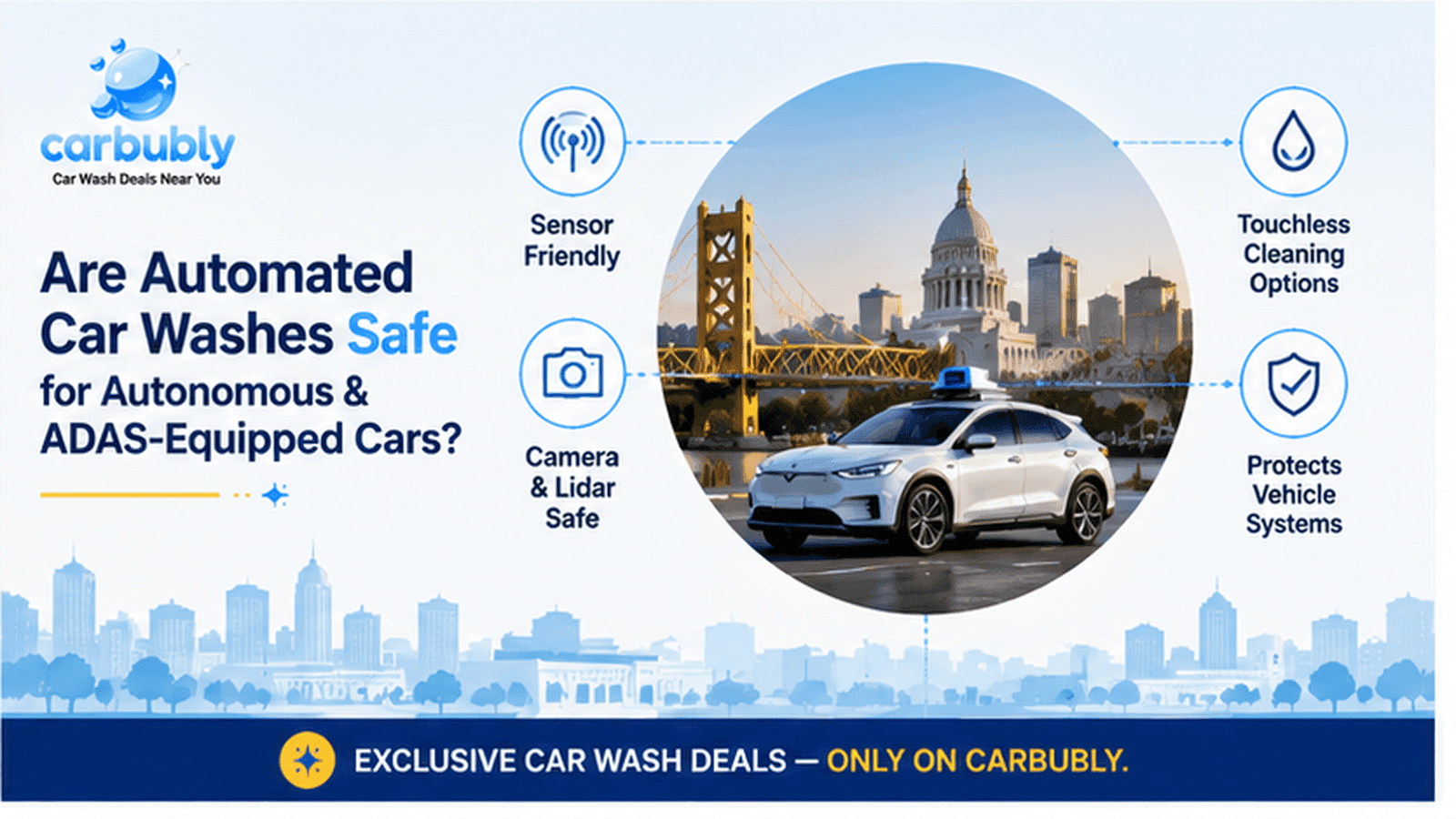
Are Automated Car Washes Safe for Autonomous & ADAS-Equipped Cars? They can be safe in some situations, but only when the vehicle owner follows the owner’s manual, prepares the car correctly, chooses the right wash type, protects cameras and sensors, and avoids washes that conflict with the vehicle’s equipment.
That answer is not meant to scare drivers away from automated car washes. Many modern vehicles go through automatic washes without a problem. But today’s cars are not as simple as older vehicles. A newer car may have forward cameras, radar sensors, parking sensors, blind-spot monitoring, lane assistance, automatic emergency braking, surround-view cameras, EV charge ports, power-folding mirrors, special wheels, low-profile trim, or software modes that need to be handled correctly.
This is especially true for Autonomous & ADAS Equipped Cars. ADAS stands for advanced driver assistance systems, and it includes features that help with braking, steering support, parking, lane alerts, blind-spot alerts, adaptive cruise control, and collision warnings. These features do not make a normal consumer vehicle fully autonomous, but they do add cameras and sensors that drivers should treat carefully.
For everyday drivers comparing “Exclusive car wash deals, only on Carbubly.”, the main lesson is simple: choose the wash that fits your vehicle, not just the closest or cheapest option.
Key Takeaways
Automated car washes can be safe for many ADAS-equipped cars, but drivers should follow the owner’s manual first.
Touchless washes may be a better choice when you want lower physical contact with cameras, trim, paint, mirrors, and exterior sensors.
Brush or cloth automatic washes may be convenient, but they can be riskier for loose trim, delicate accessories, specialty finishes, and some EV or sensor-heavy vehicles.
Tesla owners should review current Tesla car wash guidance before using automatic wash systems.
ADAS repairs and calibration can be expensive, so protecting cameras, mirrors, windshields, and radar areas matters.
Carbubly helps drivers compare hand wash, touchless wash, full-service detailing, mobile detailing, and local car wash deals from trusted providers.
What Are Autonomous & ADAS-Equipped Cars?
Autonomous & ADAS Equipped Cars are vehicles that use cameras, sensors, software, radar, lidar, ultrasonic sensors, or driver-assistance features to help with certain driving tasks.
A true autonomous vehicle can handle the driving task under specific conditions, depending on its design, authorization, and operating limits. NHTSA explains that automated driving systems may one day handle the whole driving task, but vehicles consumers can buy and use as fully self-driving cars are still a future technology, not something available to purchase and use today.
ADAS-equipped cars are different. They are common modern vehicles with features that assist the driver, but the human driver usually remains responsible. These features may include:
Automatic emergency braking
Adaptive cruise control
Lane departure warning
Lane keeping assistance
Blind-spot monitoring
Rear cross-traffic alert
Parking sensors
Backup cameras
Surround-view cameras
Driver monitoring
Traffic sign recognition
Automatic high beams
For car wash decisions, the exact label matters less than the hardware. If your vehicle has cameras, sensors, radar panels, special mirrors, EV features, or software-based driving assistance, the wash method deserves a little extra thought.
Why Automated Car Wash Safety Matters
Automated car wash safety matters because newer vehicles often place important technology on the outside of the car. A side mirror may contain a camera. A windshield may support a forward-facing camera. A bumper may contain radar or parking sensors. A grille area may include driver-assistance hardware. A rear camera may sit close to dirt, water spots, and soap residue.
That does not mean an automatic wash will damage your vehicle. It means you should understand the risk points before choosing a wash.
The scale of the issue is large. The Federal Highway Administration reported 284,614,269 registered motor vehicles in the United States in 2023 in its State Motor-Vehicle Registrations table. As more vehicles on the road include cameras, sensors, and driver-assistance features, more everyday drivers will face basic questions about wash method, sensor care, EV-safe service, and maintenance.
Repair costs also make this important. AAA studied repair scenarios involving ADAS-equipped vehicles and found that ADAS components, calibration, and related labor represented 37.6% of the averaged costs across the repair scenarios it reviewed. AAA also reported that replacing ADAS components in a minor front collision averaged $1,540.92, while windshield replacement with ADAS-related calibration averaged $360 attributable to ADAS components and calibration. Those numbers are about collision repair, not car washes, but they show why owners should avoid careless treatment around sensors, mirrors, windshields, and cameras.
What Do the Statistics Say?
A few trusted sources help explain why automated car wash choices matter for ADAS-equipped and sensor-heavy vehicles.
NHTSA separates assistance from full autonomy. NHTSA explains that automated driving systems are still evolving and that truly self-driving consumer vehicles are not available for purchase and use today. That matters because many drivers call ADAS “self-driving,” even though most systems still require driver responsibility.
ADAS hardware can be expensive to repair. AAA’s ADAS repair-cost report found that replacing ADAS components in a minor front collision averaged $1,540.92, and ADAS-related work represented 37.6% of averaged costs across four repair scenarios for the three vehicles studied. This supports careful treatment of sensor areas, mirrors, bumpers, and windshields.
Vehicle washing has environmental considerations. EPA guidance on vehicle maintenance and washing explains that vehicle washing can release pollutants such as hydrocarbons and heavy metals if wash water is not handled properly. A professional car wash may have more controlled wash-water handling than washing casually in an unsuitable place.
Fleet-style or repeated washing needs planning. EPA guidance on municipal vehicle and equipment washing notes that wash water can contain sediment, detergents, oils, grease, and heavy metals. This is relevant for rideshare cars, robotaxi fleets, EV fleets, and other high-use vehicles that may need frequent cleaning.
Tesla has specific automatic car wash instructions. Tesla’s Model Y car wash guidance explains Car Wash Mode, automatic car wash steps, and Enable Free Roll for some conveyor-style washes. This is a good reminder that the owner’s manual should guide the wash process.
The takeaway: automated car washes are not automatically bad, but modern vehicles need more preparation than older cars.
Are Automated Car Washes Safe for Autonomous & ADAS-Equipped Cars?
Automated car washes may be safe for Autonomous & ADAS Equipped Cars when the wash type matches the vehicle and the driver follows the owner’s manual. The risk is higher when the wash uses brushes or cloth strips near delicate trim, when the vehicle has loose accessories, when sensors are heavily dirty afterward, or when the driver does not activate the correct wash mode.
Before using an automated wash, check:
Owner’s manual instructions
Whether the vehicle has a car wash mode
Whether mirrors must be folded
Whether wipers must be turned off
Whether automatic braking or auto-hold settings need attention
Whether the vehicle must stay in neutral
Whether the wash is conveyor-style or stationary
Whether roof racks or accessories are allowed
Whether cameras or sensors should be cleaned after the wash
Whether the wash uses brushes, soft cloth, or touchless spray
The safest answer is not one-size-fits-all. A basic sedan with parking sensors may be fine in many automated washes. A Tesla, luxury EV, camera-heavy SUV, or vehicle with fragile accessories may need more caution.
How Automated Car Washes Work
Most automated washes fall into a few general types.
Touchless automatic wash
A touchless wash uses water pressure and detergents instead of brushes or cloth strips. It may be a good choice for ADAS-equipped cars when the goal is lower physical contact.
Touchless washes may be useful for:
Light dust
Pollen
Rain spots
Mild road film
EVs
Teslas
Vehicles with cameras
Vehicles with delicate trim
Drivers who want lower-contact cleaning
Touchless washes may not be enough for heavy bugs, thick mud, brake dust, sap, or neglected wheels.
Soft-touch or cloth automatic wash
A soft-touch wash uses moving cloth strips, foam brushes, or similar contact materials to clean the vehicle. It can be convenient and effective, but it has more physical interaction with mirrors, trim, cameras, license plates, and accessories.
Soft-touch washes may be useful for:
Regular maintenance
Moderate exterior dirt
Drivers who want faster cleaning
Vehicles approved by the owner’s manual
Cars without sensitive loose accessories
They may be less ideal for vehicles with fragile trim, aftermarket parts, roof racks, low clearance, wraps, or delicate accessories.
Conveyor tunnel wash
In a conveyor tunnel, the vehicle is moved through the wash while in neutral or a special free-roll setting. This is where owner’s manual instructions matter. Some vehicles may require a specific mode to prevent braking, locking, wiper activation, or parking brake engagement.
Tesla’s Model Y guidance, for example, explains that Car Wash Mode closes windows, locks the charge port, disables windshield wipers, disables Sentry Mode, disables walk-away door locking, and disables parking sensor chimes. It also explains Enable Free Roll for automatic car washes where the vehicle must roll freely.
Comparison: Which Wash Type Should You Choose?
Use the vehicle’s condition and technology to choose the service.
Touchless car wash: Best for light dirt, pollen, rain residue, EV-safe preferences, Tesla owners who want lower-contact cleaning, and sensor-heavy vehicles where physical contact is a concern. You can explore touchless car wash services when avoiding brush contact is important.
Hand car wash: Best for bugs, dirty wheels, lower panels, mirrors, delicate trim, cameras, and sensor-adjacent areas that need careful human attention. Compare hand car wash services when an automatic wash may not be enough.
Full-service detailing: Best when the interior needs care too, especially for rideshare cars, family SUVs, EVs, Teslas, or high-use vehicles. You can book full-service car detailing when seats, mats, glass, cup holders, odors, stains, or cargo areas need deeper cleaning.
Mobile detailing: Best when convenience matters and the provider can clean the car at an approved home, office, depot, or parking location.
Express wash: Best for a quick exterior refresh when the vehicle is lightly dirty and the owner’s manual allows the wash method.
The more technology and delicate exterior hardware your car has, the more carefully you should choose.
How to Choose the Best Option
Best for budget
Choose the lowest-cost service that still follows your owner’s manual and fits the vehicle’s condition.
Good budget choices may include:
Touchless wash for light exterior dirt
Express wash for quick maintenance
Basic hand wash for bug spots and wheels
Interior add-ons only when needed
Full detailing only when the vehicle needs deeper cleaning
A cheaper wash is not a good deal if it risks accessories, misses sensor areas, or leaves the car needing a second wash.
Best for convenience
Choose a service that fits your route and schedule. Drivers can compare car wash deals in Sacramento, car wash deals in Citrus Heights, car wash deals in Roseville, car wash deals in Rancho Cordova, car wash deals in Folsom, car wash deals in Elk Grove, car wash deals in Davis, and car wash deals in West Sacramento.
Convenience is not only distance. It includes service type, package clarity, wait time, appointment rules, vehicle restrictions, and redemption terms.
Best for protection and detailing
Choose careful service when the vehicle has:
Tesla or EV-specific features
Cameras or sensors
Driver-assistance systems
Ceramic coating
Paint protection film
Vinyl wrap
Dark paint
Roof racks
Aftermarket accessories
Bug buildup
Dirty wheels
Interior screens
Passenger wear
Protection is about process. Ask how the provider handles cameras, sensors, mirrors, trim, glass, and EV charge ports.
Common Mistakes to Avoid
Skipping the owner’s manual. The manual is the best first source for wash restrictions and setup steps.
Assuming all automated washes are the same. Touchless, soft-touch, and conveyor washes work differently.
Forgetting car wash mode. Some vehicles need specific settings before entering a tunnel wash.
Leaving wipers on automatic. Auto wipers can activate unexpectedly in a wash.
Ignoring mirrors and accessories. Fold mirrors and remove loose accessories when required.
Using a brush wash on a vehicle with delicate trim or wrap. Check whether the wash method is appropriate.
Assuming ADAS means fully autonomous. Most ADAS-equipped cars still require an attentive human driver.
Not checking sensors after the wash. Soap residue, water spots, or remaining grime can collect around cameras and sensors.
Choosing only by price. A cheap wash may not be the right wash for a sensor-heavy vehicle.
Ignoring Tesla or EV instructions. Follow manufacturer guidance before automatic wash use.
Maintenance Tips After an Automated Car Wash
After the wash, take one minute to inspect the vehicle before driving away.
Check:
Front camera area
Rear camera lens
Side cameras
Parking sensors
Radar or grille area, if visible
Windshield
Mirrors
Headlights
Taillights
License plate area
Charge port
Wipers
Wheels
Loose trim
Any warning messages
If a warning appears, follow the vehicle’s instructions. If a camera view looks blurry, inspect for water spots, soap residue, or remaining dirt. Do not scrape sensor areas with harsh tools.
Where Carbubly Fits Naturally
Carbubly is a marketplace for car wash deals that helps drivers discover, compare, purchase, and redeem offers from trusted local car wash and detailing providers.
Carbubly is not a car wash operator. It does not personally wash vehicles. Instead, it helps drivers compare local providers offering hand car wash, touchless car wash, express wash, mobile detailing, full-service detailing, Tesla car wash options, EV-safe car wash preferences, and other vehicle-cleaning services.
Start with Carbubly when you want to compare affordable car wash options, trusted car wash services, local car wash providers, and car wash savings. You can also view Carbubly on Google Maps for local trust context.
For Autonomous & ADAS Equipped Cars, comparison matters. You are not only comparing price. You are comparing wash type, vehicle fit, provider clarity, EV awareness, detailing options, and whether the service makes sense for your vehicle’s technology.
Final Tips Before Choosing an Automated Wash
Use this checklist before entering an automated car wash:
Read the owner’s manual.
Check whether your vehicle has a car wash mode.
Turn off automatic wipers if required.
Fold mirrors if needed.
Remove loose exterior accessories.
Confirm roof racks or attachments are allowed.
Check whether the wash is touchless, soft-touch, or conveyor-style.
Use the correct neutral or free-roll setting if required.
Close windows, sunroof, trunk, hood, fuel door, and charge port.
Avoid high-contact washes if your vehicle has delicate trim, wrap, or accessories.
Inspect cameras and sensors after the wash.
Choose hand wash or detailing when bugs, sap, wheels, or interior mess need more care.
Follow Tesla or EV-specific guidance when relevant.
Compare deal terms before booking.
A little preparation helps protect both the vehicle and your peace of mind.
Conclusion: Are Automated Car Washes Safe for Autonomous & ADAS-Equipped Cars?
Are Automated Car Washes Safe for Autonomous & ADAS-Equipped Cars? Yes, they can be safe when the wash method matches the vehicle, the owner follows the manual, and the car is prepared correctly. The safest choice depends on the car’s sensors, cameras, mirrors, EV features, trim, accessories, paint condition, and the type of wash being used.
For light dirt, a touchless car wash may be a smart lower-contact option. For bugs, dirty wheels, lower panels, and delicate areas, a hand car wash may be better. For interior mess, odor, pet hair, stains, or passenger wear, full-service detailing or mobile detailing may provide more value.
Carbubly helps drivers compare local car wash and detailing deals from trusted providers, so you can choose based on service fit, vehicle type, location, and value. Visit Carbubly to compare nearby options before choosing a wash for your ADAS-equipped car, EV, Tesla, or sensor-heavy vehicle.
FAQs About Automated Car Washes and ADAS Cars
1. Are Automated Car Washes Safe for Autonomous & ADAS-Equipped Cars?
Are Automated Car Washes Safe for Autonomous & ADAS-Equipped Cars? They can be safe when the owner follows the vehicle manual, prepares the car correctly, and chooses a wash method that fits the vehicle’s sensors, cameras, trim, and EV features.
2. What should I do before taking an ADAS-equipped car through a car wash?
Before taking an ADAS-equipped car through a car wash, read the owner’s manual, turn off automatic wipers if needed, fold mirrors, secure accessories, choose the correct wash mode, and inspect cameras and sensors afterward.
3. Is a touchless car wash better for ADAS-equipped cars?
A touchless car wash may be better when you want lower physical contact around cameras, sensors, mirrors, trim, and paint. It may not remove heavy bugs, sap, or wheel grime as well as hand washing.
4. Can automatic car washes damage sensors?
An automatic car wash may not normally damage sensors, but loose parts, harsh contact, strong pressure in the wrong area, or existing damage can create risk. Always follow the manufacturer’s guidance.
5. Should Tesla owners use automatic car washes?
Tesla owners should review Tesla’s current car wash guidance before using an automatic wash. Some situations may require Car Wash Mode, Enable Free Roll, or other specific steps.
6. Do ADAS cameras need cleaning after a car wash?
Yes, it is smart to check cameras after a wash. Water spots, soap residue, or remaining grime can affect camera visibility or trigger warnings.
7. Is hand washing safer than automated washing?
Hand washing can be safer for delicate areas when done correctly with clean tools and careful technique. Poor hand washing can still scratch paint or miss important areas.
8. Can I use an automated wash with a roof rack or bike rack?
Check both the vehicle manual and the car wash rules. Many automated washes restrict roof racks, bike racks, cargo boxes, loose attachments, and oversized accessories.
9. Are automated washes safe for EVs?
Automated washes can be safe for many EVs when the owner follows the manual, secures the charge port, uses the correct wash mode, and chooses a suitable wash type.
10. Where can I compare ADAS-friendly car wash options?
You can compare car wash deals on Carbubly, a marketplace that helps drivers discover, compare, purchase, and redeem offers from trusted local car wash and detailing providers.