


Protect Your Tesla with Hand Car Wash Services in Sacramento
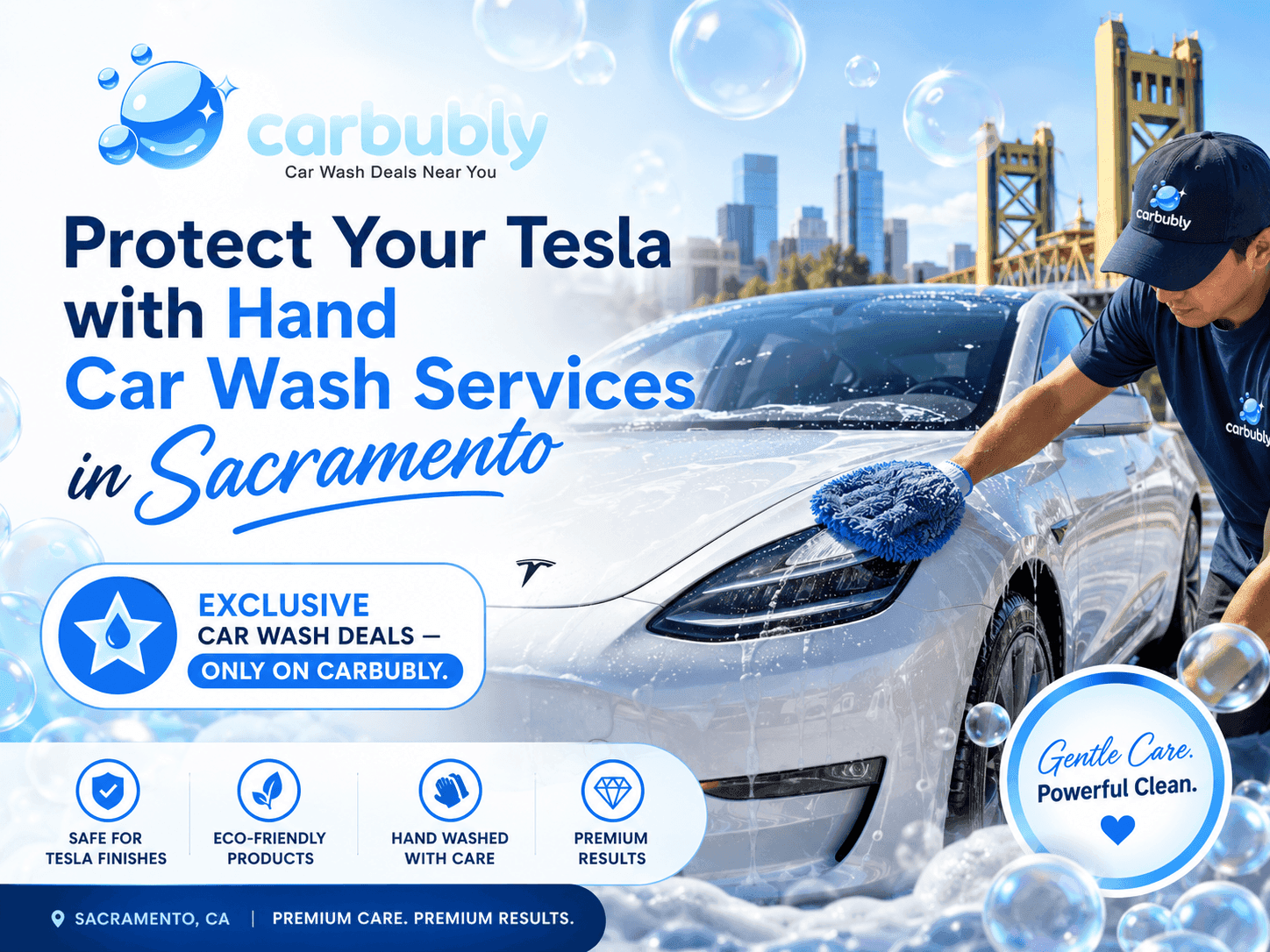
Tesla vehicles are built with sensitive sensors, ceramic-coated paint, and precision bodywork that standard automated car washes can damage in ways you might not notice right away. The safest approach to maintaining your Tesla's exterior is through professional hand washing, which gives technicians the control to clean every surface without putting pressure on cameras, Autopilot sensors, or painted panels.
Key Takeaways
- Automated brush car washes can scratch Tesla paint, snag door handles, and misalign exterior sensors over time.
- Hand washing is the only cleaning method that allows for direct inspection of your Tesla's body panels as they're cleaned.
- Tesla's satin and matte finishes require pH-neutral soaps and soft microfiber cloths that most automated machines do not use.
- Sacramento's dry, dusty climate means your Tesla accumulates abrasive particulates that need to be rinsed off carefully before any wiping occurs.
- Touchless options exist as a middle ground but still carry risks for vehicles with aftermarket wraps or paint protection film.
- Combining hand washing with periodic full detailing gives your Tesla the most comprehensive exterior care available.
Why Tesla Vehicles Demand Special Washing Care
Tesla models are not like conventional gas-powered cars when it comes to exterior maintenance. The Model 3, Model Y, Model S, and Model X all feature flush door handles, forward-facing cameras integrated into the body, ultrasonic sensors embedded in bumpers, and, in many cases, premium paint finishes that Tesla itself acknowledges require extra attention.
Tesla's own owner manual, which you can review through Tesla's official support documentation, recommends against using automatic car washes with brushes and warns that improper washing techniques can void paint warranty coverage. That is a real financial risk, not a hypothetical one.
Here is what can go wrong with automated car washes and Teslas specifically:
- Brush contact with flush door handles: The pop-out door handles on older Model S and X vehicles and the flush handles on newer models can catch on rotating brush arms, causing mechanical damage.
- Camera lens abrasion: Dirty, bristle-loaded brushes drag debris across camera housings, scratching lenses that feed into your Autopilot and FSD systems.
- Paint swirl marks: High-speed brushes trap grit from previous vehicles and grind it across your clear coat, creating micro-scratches visible under direct sunlight.
- Water intrusion near charge port: High-pressure jets aimed at the charge port area can force water into the housing over time.
The National Highway Traffic Safety Administration has tracked sensor-related failures in semi-autonomous vehicles, and while automated car washes are not a primary cause, any repeated physical contact with sensor housings contributes to degraded accuracy.
What a Professional Hand Car Wash Actually Does Differently
When you take your Tesla to a quality hand car wash provider, the process is fundamentally different from what a tunnel wash offers. It starts with a thorough pre-rinse that loosens and floats off surface contaminants before any physical contact is made. This step alone eliminates the majority of the scratching risk that comes from wiping a dusty car.
From there, trained technicians use two-bucket wash methods (one for clean soapy water, one for rinsing the mitt), pH-neutral or pH-balanced soaps formulated for automotive clear coats, and microfiber wash mitts that trap rather than drag particles. They work panel by panel, top to bottom, with attention to body lines, wheel arches, mirror housings, and other areas that automated machines often miss entirely.
Here is a direct comparison of washing methods relevant to Tesla owners:
| Wash Method | Paint Safety | Sensor Safety | Time Required | Cost Range |
|---|---|---|---|---|
| Automated Brush Tunnel | Low | Low | 5-10 min | $8-$20 |
| Touchless Automated | Medium | Medium | 5-15 min | $10-$25 |
| DIY Home Wash | Medium-High | High | 45-90 min | $5-$15 |
| Professional Hand Wash | High | High | 20-45 min | $25-$75 |
| Full Service Detail | Very High | Very High | 2-6 hours | $150-$500+ |
The cost difference between a brush tunnel and a professional hand wash is typically less than $20 per visit. For a vehicle that costs anywhere from $40,000 to over $100,000, that is a straightforward value decision.
Sacramento's Environment and Your Tesla's Paint
Sacramento presents a specific set of environmental challenges for Tesla owners. The Central Valley region experiences long dry summers with high dust and agricultural particulate loads in the air. Pollen counts spike in spring. Brake dust and road grime accumulate quickly on low-clearance EVs that sit closer to the road surface than many traditional vehicles.
According to air quality data tracked by the California Air Resources Board, the Sacramento Valley regularly records elevated particulate matter levels, particularly during summer months. Those particles settle on your Tesla's paint and, if wiped off without a proper pre-rinse, act like fine sandpaper against your clear coat.
Tree sap from the region's abundant oak and pine trees is another real concern. Sap bonds to clear coat within days of contact, and if left too long, its removal requires chemical intervention that can dull the finish if done improperly. A technician doing a full service car detailing session will identify and treat these contamination points individually, something no automated process can replicate.
If you live or work in the sacramento metro area, finding a hand wash provider familiar with these regional conditions is important. Local providers understand the specific dust composition and pollen types in the area and adjust their pre-wash and drying techniques accordingly.
For Tesla owners based east of the city, the folsom area also offers access to quality hand wash services that understand the foothill environment, where red clay dust and road debris from Highway 50 add their own challenges to paint care.
When Touchless Washing Is and Is Not Appropriate for Teslas
A touchless car wash uses high-pressure water jets and chemical detergents with no brush or physical contact, which removes the abrasion risk that comes from bristles and mitts. For a Tesla without any paint protection film, ceramic coating, or vinyl wrap, a touchless wash is a significantly safer option than any brush-based system.
However, touchless washing has its own trade-offs for Tesla owners:
- Aggressive chemical detergents: To compensate for the lack of physical agitation, touchless systems use stronger alkaline or acidic cleaners. These can strip wax protection over time and may degrade the adhesive edges of vinyl wraps or paint protection film.
- Incomplete cleaning: Touchless washes often leave water spots, road film residue in body creases, and brake dust on wheel faces because there is no physical action to dislodge them.
- High-pressure risk near sensors: Even without brushes, high-pressure jets directed at sensor housings and camera lenses at close range can cause issues.
Touchless is a reasonable option for light maintenance washes between full hand washes, particularly during winter months when road salt is not a regional concern for drivers in the roseville area. However, it should not replace a thorough hand wash on a regular basis.
The American Detailing Institute and similar professional organizations recommend that EV owners prioritize contact washing only when performed by trained technicians using proper two-bucket methods, not by untrained individuals with standard household supplies.
How Often Should You Have Your Tesla Hand Washed
Frequency depends on how you use your Tesla and where you park it. Below are general guidelines based on common Sacramento driving patterns:
- Daily commuters on I-5, I-80, or Highway 50: Every 1-2 weeks during dry season, weekly during the brief winter rainy season when road spray is heavier.
- Parked outdoors under trees: Every 7-10 days to prevent sap and bird dropping etching, both of which act quickly on exposed clear coat.
- Parked in a garage, light daily use: Every 2-3 weeks is typically sufficient.
- Long road trips or Central Valley highway driving: Wash within 48-72 hours of return due to bug splatter, which is highly acidic and bonds to paint rapidly at highway temperatures.
The Mayo Clinic's research on particulate matter notes that fine particles in the air are not just a health concern. They are the same particles settling on your vehicle's surface every day, and drivers in communities like citrus heights and elk grove experience this more acutely during peak air quality alert days. Regular washing is maintenance, not vanity.
Things to Know
- Tesla's official guidance recommends using only pH-neutral soaps when washing any Tesla model. Check the current Tesla cleaning guidelines for model-specific instructions.
- "Car Wash Mode" on Tesla vehicles closes windows, locks charge ports, and folds mirrors automatically. Enable it before any wash, hand or otherwise.
- Paint protection film (PPF) requires even more careful washing than bare paint. High-pressure edges can lift film corners if the installer's edges are not fully sealed.
- Ceramic coatings reduce how often you need full washes by making surfaces hydrophobic, but they still require regular rinsing and proper hand washing to maintain their performance.
- Wheel cleaning is often skipped by lower-cost wash services, and it is especially important for drivers in areas like rancho cordova where road dust accumulation is heavy. Brake dust is corrosive and should be removed from Tesla's induction wheels or aero covers at every wash.
- Your Tesla's exterior cameras can be checked for clarity after each wash. Cloudiness or streaking on the lens cover is a sign the wash technique was too aggressive or the wrong products were used.
Ready to Schedule a Proper Wash for Your Tesla?
Start by checking whether your current car wash provider has specific experience with EVs and Tesla models in particular. Ask directly whether they use the two-bucket method, what soap formulation they use, and whether their technicians are trained to work around sensor housings. If they cannot answer those questions clearly, that tells you what you need to know.
You can also visit the Carbubly website to explore available services in the Sacramento region, and if you are located in surrounding communities like davis or west sacramento, you can find hand wash options that are specifically suited to modern EVs. You can also view the place on Google Maps to see the location and hours of operation.
Frequently Asked Questions
Q: Can I take my Tesla through a regular drive-through car wash?
Tesla's official guidance is to avoid automatic car washes with brushes and to use touchless or hand wash options instead.
Brush-based tunnel washes can catch on flush door handles, scratch camera lenses, and leave paint swirl marks that are expensive to correct. If you must use an automated facility, touchless-only is the safer choice, though it still carries some risk.
Q: How do I use Car Wash Mode on my Tesla before a hand wash?
Access Car Wash Mode through your Tesla's touchscreen under Controls, then Service, then Car Wash Mode.
This mode closes all windows, locks the charge port, disables parking sensors, and folds the mirrors. You should activate it every time your Tesla is being washed, regardless of wash type.
Q: Does hand washing remove water spots from my Tesla's paint?
A professional hand wash with the right detailing clay and finishing spray can remove light water spots, but heavy mineral deposits may require a light paint correction step.
Sacramento's water supply contains moderate mineral content that can leave spotting on paint, especially if the car is air-dried rather than immediately hand-dried with a clean microfiber towel.
Q: Is a hand car wash safe for a Tesla with a matte or satin paint finish?
Yes, but only when the technician uses matte-specific products, since standard wax and polish compounds will add unwanted gloss to matte and satin finishes.
Always confirm with your provider that they carry matte-safe washing and drying products. Not all hand wash services stock these specialty products.
Q: How much does a professional hand car wash typically cost for a Tesla in Sacramento?
You can expect to pay between $30 and $75 for a standard professional hand wash on a Tesla, depending on vehicle size and add-on services like wheel cleaning or interior wipe-down.
Larger models like the Model X or Model S command slightly higher prices due to their surface area. Full detailing sessions start at $150 and can exceed $400 for comprehensive paint correction and protection treatments.
The Bottom Line on Protecting Your Tesla with Hand Car Wash Services in Sacramento
To protect your Tesla with hand car wash services in Sacramento, the key is consistency and choosing providers who understand EV-specific requirements. One careless automated wash can undo months of careful maintenance, while a regular routine with a qualified hand wash service keeps your Tesla's paint, sensors, and camera lenses in the condition they were designed to maintain.
Your Tesla is a long-term investment. Treating its exterior with the same precision that went into engineering it is not overcautious. It is basic ownership responsibility. Find a Sacramento-area provider with documented EV experience, ask the right questions before your first appointment, and commit to a wash schedule that matches your actual driving and parking conditions.